 keymodels
Product quality and satisfaction (Kano)
How can product quality and satisfaction (kano) support strategic choice or positioning?
Contents
Noriaki Kano’s model of product development and customer satisfaction develops this theme extensively.
The Kano model explains why product attributes do not all affect satisfaction in the same way. Some are expected basics, some improve satisfaction in proportion to performance, and some create delight when present without being missed when absent. The framework helps product teams decide where reliability, performance and innovation each matter.
When to use it
- Use it when product development is part of a growth option.
- Prioritise attributes across customer segments and propositions.
- Distinguish missing basics from opportunities to delight.
- Revisit classifications as expectations and alternatives change.
Origins
Noriaki Kano, Nobuhiko Seraku, Fumio Takahashi and Shin-ichi Tsuji presented the underlying attractive-quality and must-be-quality theory in 1984 in the journal of the Japanese Society for Quality Control. Their work challenged a one-dimensional assumption that more of every quality attribute creates proportionally more satisfaction.
“Product” is one of the 4Ps of marketing. Kano adds a more precise question: which product or service characteristics satisfy a customer, and how does the pattern change when an attribute is present or absent?
What it is
“I don’t think architecture is only about shelter … it should be able to excite you,” said architect Zaha Hadid. Kano’s model separates attributes that merely prevent disappointment from those capable of excitement.
The five common categories are:
- Attractive
- creates satisfaction when present but little dissatisfaction when absent; also called an exciter.
- One-dimensional
- greater performance increases satisfaction and lower performance increases dissatisfaction; also called a performance attribute.
- Must-be
- expected as a basic condition; presence receives little credit but absence causes strong dissatisfaction.
- Indifferent
- produces little satisfaction or dissatisfaction either way for the studied customer.
- Reverse
- creates dissatisfaction when present for some customers, meaning preferences run opposite to the proposed direction.
Survey responses can also be inconsistent or questionable and should not be forced into a substantive category.
Product quality and customer satisfaction
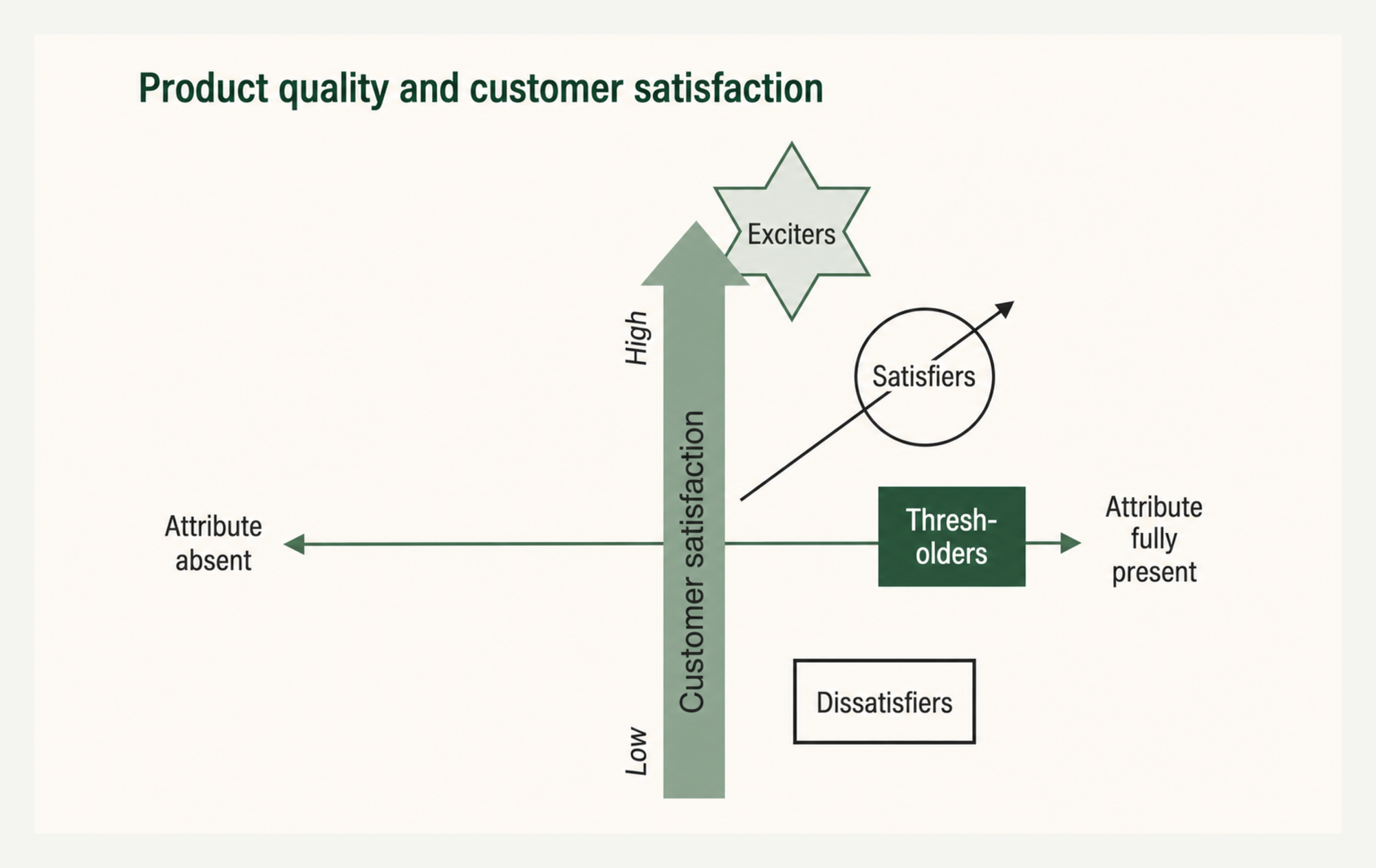
The categories are segment- and time-specific. An innovation that once delighted customers may become a performance attribute and later a must-be expectation. Cost, safety, accessibility, environmental effect and strategic fit are not captured by the satisfaction curve and need separate analysis.
Continue your preview
Read more of Product quality and satisfaction (Kano).
Create a free account to continue this advanced article preview. Complete access is available with Pro or an eligible outcome pack, so you can see the value before deciding to upgrade.