 keymodels
Innovation hot spots (Gratton)
How can innovation hot spots (gratton) support strategic choice or positioning?
Contents
Gratton says that you always know when you are in a hot spot. You feel energised and vibrantly alive.
Innovation hot spots are teams or networks in which people feel unusually energised and combine knowledge to create useful new value. Lynda Gratton’s model explains the social conditions that make these bursts of productive innovation more likely.
When to use it
Use the model when an organisation needs stronger collaboration and innovation, particularly where expertise remains trapped inside teams or formal boundaries.
Origins
Lynda Gratton developed the hot-spots framework through research with 57 companies and presented it in her 2007 book Hot Spots: Why Some Teams, Workplaces, and Organizations Buzz with Energy—and Others Don’t. Her work identified three multiplicative sources of potential energy and a fourth capability that converts it into productive results.
What it is
A hot spot depends on four elements:
- Cooperative mindset:
- relationships are grounded in trust, mutuality and willingness to contribute.
- Boundary spanning:
- people connect across functions, organisations, disciplines and social groups, bringing unlike knowledge together.
- Igniting purpose:
- a compelling question, challenge or vision concentrates voluntary energy.
- Productive capacity:
- the group can discuss, resolve conflict, coordinate and turn ideas into work.
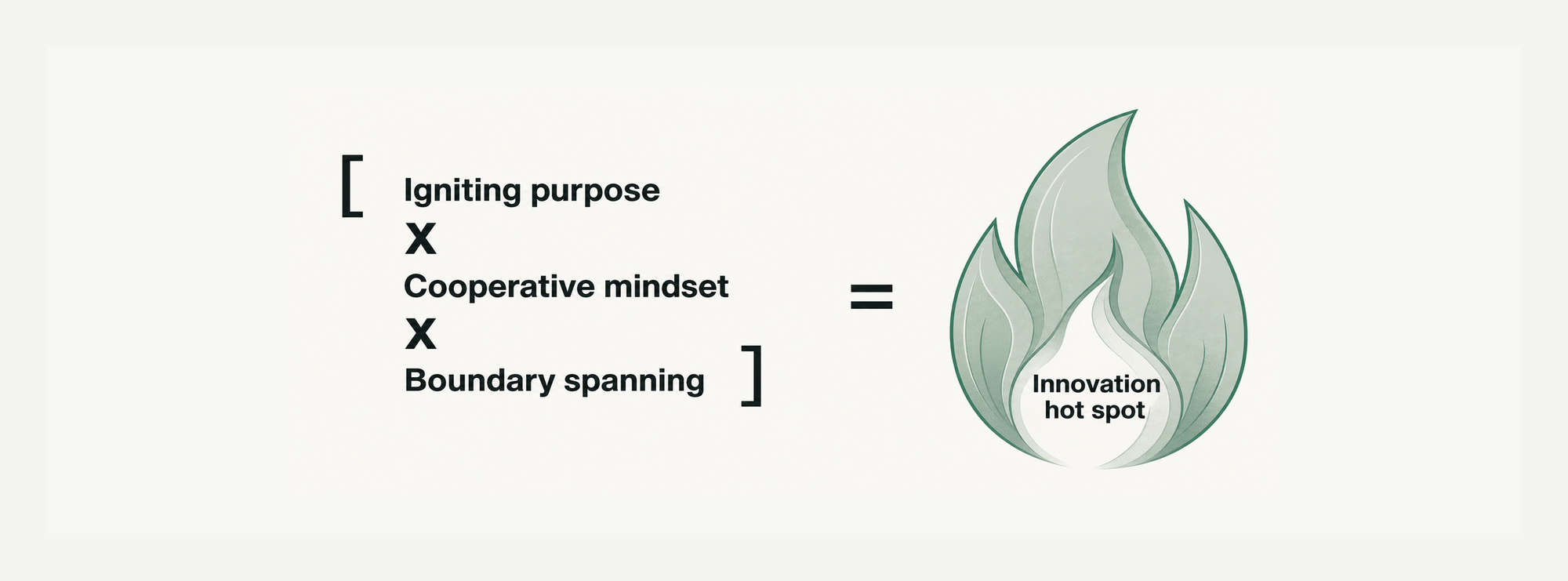
The first three conditions multiply potential energy, so a severe weakness in one can collapse the whole effect. Productive capacity then determines whether excitement becomes innovation and value rather than conversation alone.
Leadership is less about directing every action than creating conditions: connecting networks, framing meaningful challenges, protecting constructive disagreement and building the team’s ability to deliver. This does not mean withdrawing accountability or resources.
Continue your preview
Read more of Innovation hot spots (Gratton).
Create a free account to continue this advanced article preview. Complete access is available with Pro or an eligible outcome pack, so you can see the value before deciding to upgrade.