 keymodels
Ansoff’s matrix and product market grid
How can ansoff’s matrix and product market grid support strategic choice or positioning?
Contents
The Ansoff product/market grid offers a logical way of determining the scope and direction of a firm’s strategic development in the marketplace.
Ansoff’s product/market grid provides a disciplined way to define the scope and direction of a company’s development in the market. It distinguishes two connected decisions: portfolio strategy, which establishes where the firm intends to compete, and competitive strategy, which defines how it will succeed there.
When to use it
The appropriate route to corporate growth depends on the risk the organisation can accept, its current portfolio of products and markets, and whether it intends to build around existing or new offers and customers. Systematic planning begins with a clear view of the distance between today’s position and the desired future one. The product/market grid and the later Ansoff cube help managers describe that gap and identify possible growth directions.
Ansoff identified four interdependent components of portfolio strategy that define the intended scope:
- The geographical growth vector
- Competitive advantage
- Synergy
- Strategic flexibility.
The Ansoff cube expresses the geographical growth vector by connecting the organisation’s present scope with the scope it wants to occupy.
Competitive advantage must both make the chosen destination attainable and sustain the journey towards it. That advantage might arise from a core competence, protected technology or after-sales service that competitors cannot match.
Synergy asks how the firm’s competencies reinforce one another. Effective combinations can create economies of scale and strengthen its position against competitors.
Strategic flexibility limits the damage from unforeseen events by avoiding commitments and organisational “ballast” that unnecessarily constrain the firm’s response.
These components cannot be maximised independently. Improving one may weaken another; extracting the greatest possible synergy, for example, often reduces flexibility by increasing interdependence. Selecting strategic objectives is therefore an exercise in balancing competing benefits.
Origins
Igor Ansoff introduced the product/market framework in his nineteen fifty-seven Harvard Business Review article “Strategies for Diversification” and developed it further in Corporate Strategy (nineteen sixty-five). In the original grid, portfolio objectives were expressed as a growth vector leading towards the firm’s future scope. His later work replaced that two-dimensional formulation with a geographical growth vector that added a third dimension and described strategic scope more realistically.
What it is
Portfolio strategy sets the objective for each product–market combination—the points on the horizon. Competitive strategy selects the route by which the organisation will reach them.
In the original grid, the portfolio objective is a growth vector that describes the desired business scope using two dimensions: products and markets.
Ansoff subsequently replaced that vector with a three-dimensional geographical growth vector. A firm can define its intended scope through:
- Market need
- , such as personal transportation or amplification of electrical signals.
- Product or service technology
- , such as integrated-circuit technology.
- Market geography
- , such as particular regions or countries.
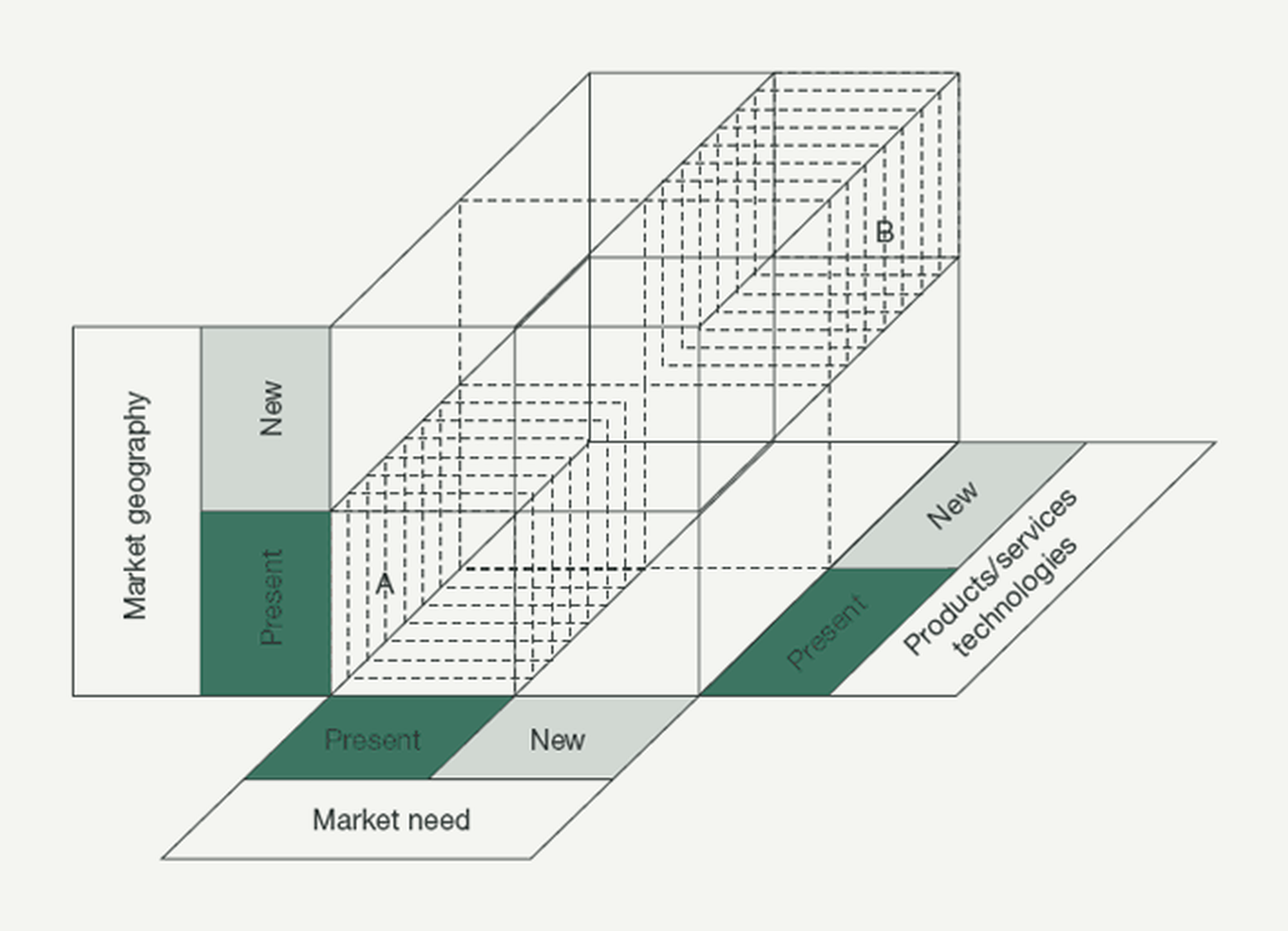
Together, the dimensions create a cube containing many possible strategic positions. At one extreme, a company continues to meet familiar needs in current regions with established technologies. At the other, it uses new technologies to address new needs in unfamiliar regions.
Market development: selling existing products to new markets
This route creates opportunities to:
- reach new customers in additional geographies;
- enter industry or demographic segments not served before.
A healthy business usually combines deeper existing relationships with a continuing supply of new customers. Some established buyers will inevitably leave because they no longer need the product or prefer an alternative. Replacing those losses merely holds revenue steady; acquisition must exceed churn for the company to grow.
Market development seeks customers in new geographies or new segments within a current geography. Consumer businesses may target another demographic, while B2B companies can approach a different industry vertical. Gillette, for example, adapted disposable razors designed for men to appeal to women. Guinness expanded beyond its association with older drinkers by positioning its stout to younger audiences as cool, intelligent, original and distinct from light beers and lagers.
Acquisition remains difficult. A promotional campaign cannot simply summon revenue: unfamiliar prospects must first recognise the supplier, become interested in the offer and develop enough desire to buy. The AIDA framework describes that progression.
Product development: selling new products to existing markets
This option creates opportunities to:
- offer additional products to current customers;
- discover and meet needs that existing markets do not yet satisfy.
Existing trust gives a supplier an advantage when introducing another product. Customers already understand what the brand represents and may welcome an adjacent offer, whether developed internally or licensed into the portfolio. Extensions are most likely to work when they solve a genuine customer need and remain meaningfully connected to the established brand.
A bread baker might add meat pies or confectionery; an airline could sell holidays to loyal travellers; a machinery supplier could provide contract maintenance. Each offer has a clear relationship to the original business. The further an extension travels from the brand’s core meaning, the harder it becomes to earn acceptance. Virgin’s challenger identity transferred successfully from music into airlines and rail, but produced weaker results in categories including wine, cola, condoms and bridal wear.
Diversification: selling new products to new markets
It includes opportunities to:
- develop new products for unfamiliar geographies or segments;
- acquire a company operating in another field.
Unfamiliar markets can look more attractive from a distance, encouraging companies to imagine easier sources of profit elsewhere. Yet selling an unproven product to customers who do not know the company is effectively a start-up. The offer must work, the supplier must become credible and established competitors must be overcome.
Successful diversification therefore attracts attention. Husqvarna is now associated with chainsaws and lawnmowers, but across several centuries it has produced muskets, bicycles, motorcycles, kitchen equipment and sewing machines for very different audiences. Apple likewise moved beyond computers and became heavily dependent on the iPhone. Such visible successes obscure many failed attempts. Diversification is the most demanding of Ansoff’s four routes, though its rewards can be transformative.
Continue your preview
Read more of Ansoff’s matrix and product market grid.
Create a free account to continue this advanced article preview. Complete access is available with Pro or an eligible outcome pack, so you can see the value before deciding to upgrade.