
Business scope (Abell)
How can business scope (abell) support strategic choice or positioning?
Contents
The business definition model introduced by Derek Abell (1980) defines and considers a company on the basis of three dimensions: the customers (who), their needs (what).
Derek Abell’s business-definition model describes a company through three dimensions: the customer groups it serves, the customer needs or functions it satisfies, and the technologies and capabilities it uses to do so. Framed as who, what and how, the model makes the current scope of a business visible and exposes possible directions for expansion, focus or reinvention.
When to use it
Use the model when leaders need a customer-centred answer to “What business are we in?” It supports strategic planning by:
- defining the organisation’s current position without relying only on products or industry labels;
- comparing the scope of business units or competitors;
- identifying adjacent customer groups, unmet needs and alternative ways of satisfying them;
- deciding where the organisation should expand or deliberately narrow its scope; and
- translating a broad ambition into explicit choices about where the firm will and will not compete.
Origins
Derek F. Abell introduced the three-dimensional approach in Defining the Business: The Starting Point of Strategic Planning (1980). He argued that conventional product-and-market descriptions were too narrow because products and technologies change while customer functions may persist. Defining a business through customer groups, customer functions and alternative technologies offered a more durable basis for strategic choice.
What it is
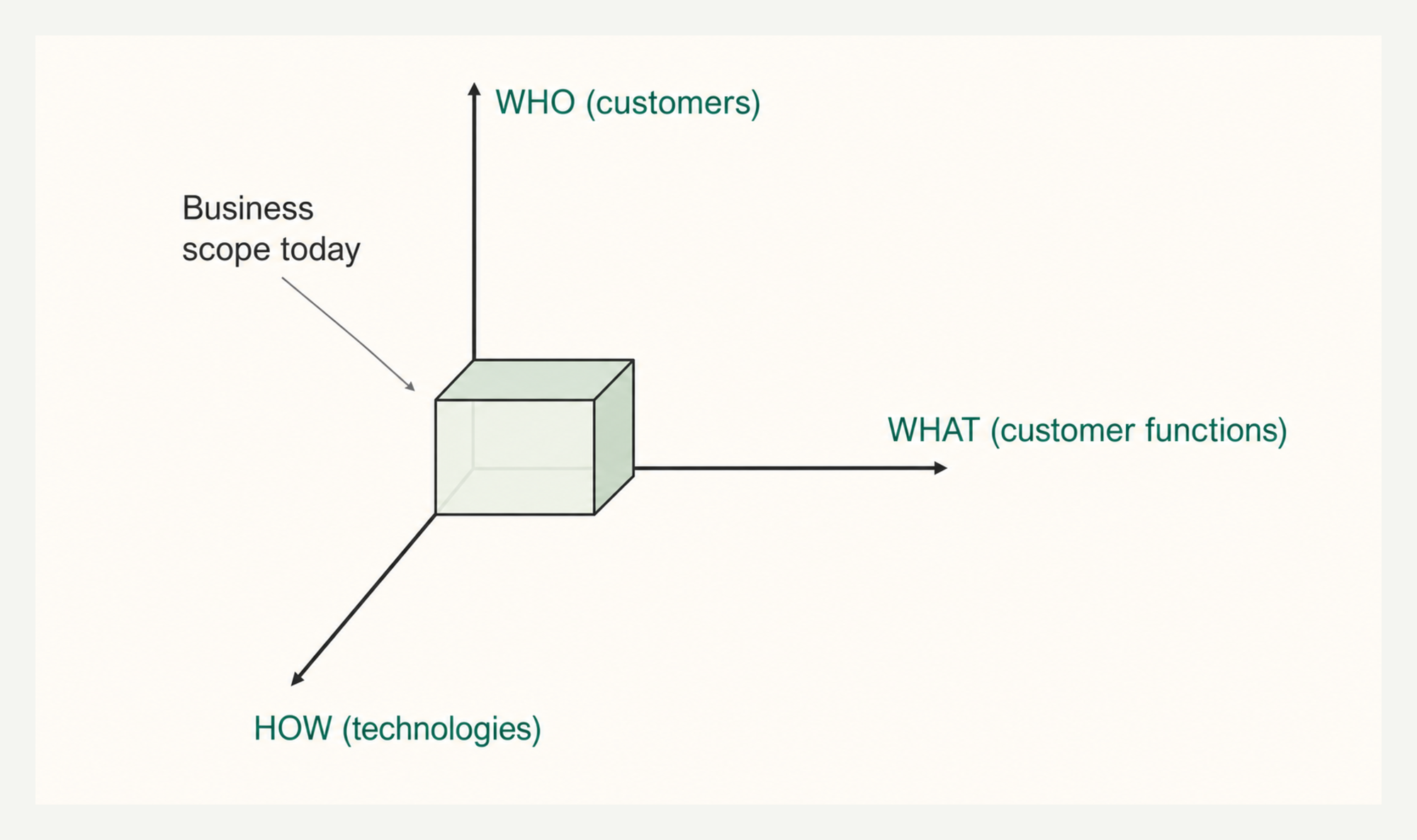
The model creates a three-dimensional space. Any current business occupies only part of that space: a selected group of customers, a selected set of needs and a selected collection of technologies or competencies. Mapping that occupied area clarifies the existing definition; considering other combinations reveals potential strategic moves.
How to use it
Answer three questions from the market’s perspective:
- Who is served? Define meaningful customer groups rather than describing the organisation’s internal sales structure. Distinguish groups whose context, economics or requirements call for different treatment.
- What is satisfied? Identify the functions, problems or needs for which customers seek an outcome. Avoid substituting a current product category for the underlying need.
- How is it satisfied? Specify the technologies, competencies, delivery systems and partner capabilities used to fulfil those needs better than alternatives.
First map the current business. Gather a cross-functional group and list the principal elements on each axis. Mark the combinations the organisation actually serves, the relative importance of each and the evidence supporting the map. This creates a shared reference point and often exposes disagreement hidden by a broad mission statement.
Next create a future map, commonly three to five years ahead. Explore possible movement along one dimension at a time and then in combination: serving a new customer with the current need and technology, meeting a new need for existing customers, or using an alternative technology to satisfy the same function. Assess each option for attractiveness, capability fit, investment, risk and competitive advantage.
Finally, choose the intended scope and its boundaries. State what will remain outside the business as clearly as what will be included, translate the choices into strategic goals and identify the capabilities or partnerships needed to reach the future position.
Final analysis
Abell’s model is simple enough to structure a strategic conversation yet broad enough to reveal paths beyond the current product line. Its value is not limited to growth: removing marginal combinations and defining a narrower position can be equally strategic.
The how dimension usually demands the most care because it may combine technology, know-how, channels, systems and external partners. If it becomes unwieldy, split the question into “With which technology and competencies?” and “With which partners and delivery system?”
That detail can also push the discussion from scope into full business-model design. Abell clarifies where the business competes and the basis on which customer needs are met; it does not fully explain revenue logic, costs or operating relationships. Use a business model canvas when those questions become central.
Top practical tip
Describe the current and future business with concrete entries on all three axes—who, what and how—and identify the combinations you deliberately choose not to pursue.
Top pitfall
Do not define customer needs with the name of your current product. Doing so hides substitution risk and makes the future look artificially similar to the present.
Further reading
Abell, D.F. (1980) Defining the Business: the Starting Point of Strategic Planning. Prentice Hall.