
keymodels
Menu
StrategyFramework / modelModelAccessible

Value disciplines

How can value disciplines support strategic choice or positioning?

AccessibleStrategicOrganisation2 min read
Contents

The basic idea of this model is that no company can be all things to all people.

The value disciplines model argues that an organisation cannot lead its market by trying to be everything to everyone. It needs a coherent value proposition, an operating model designed to deliver it and a clear discipline that guides trade-offs.

When to use it

Use the framework when reviewing what customers value, why they choose the organisation and whether its systems reinforce a distinctive promise. It is especially helpful when strategy feels like an unprioritised list of desirable qualities or when leaders need to reconnect the organisation’s purpose with the customers it intends to serve.

Origins

Michael Treacy and Fred Wiersema introduced the value-disciplines framework through research on market leaders and developed it in their 1995 work. They proposed that leading companies select one primary way of delivering superior value—operational excellence, product leadership or customer intimacy—while meeting an acceptable market threshold in the other two.

What it is

The three disciplines are:

  • Operational excellence: Deliver dependable products or services with minimal cost and inconvenience through standardisation, efficient flow and disciplined execution.
  • Product leadership: Continually create and commercialise leading offerings, accepting experimentation and failure in exchange for innovation and speed.
  • Customer intimacy: Understand selected customers deeply and provide a responsive total solution, investing in relationships and tailoring where lifetime value justifies it.

A discipline is more than a marketing claim. It requires aligned processes, structure, technology, measures, capabilities and culture. Trying to maximise all three simultaneously can create incompatible priorities; nevertheless, neglecting the minimum standard in any discipline can disqualify the offer.
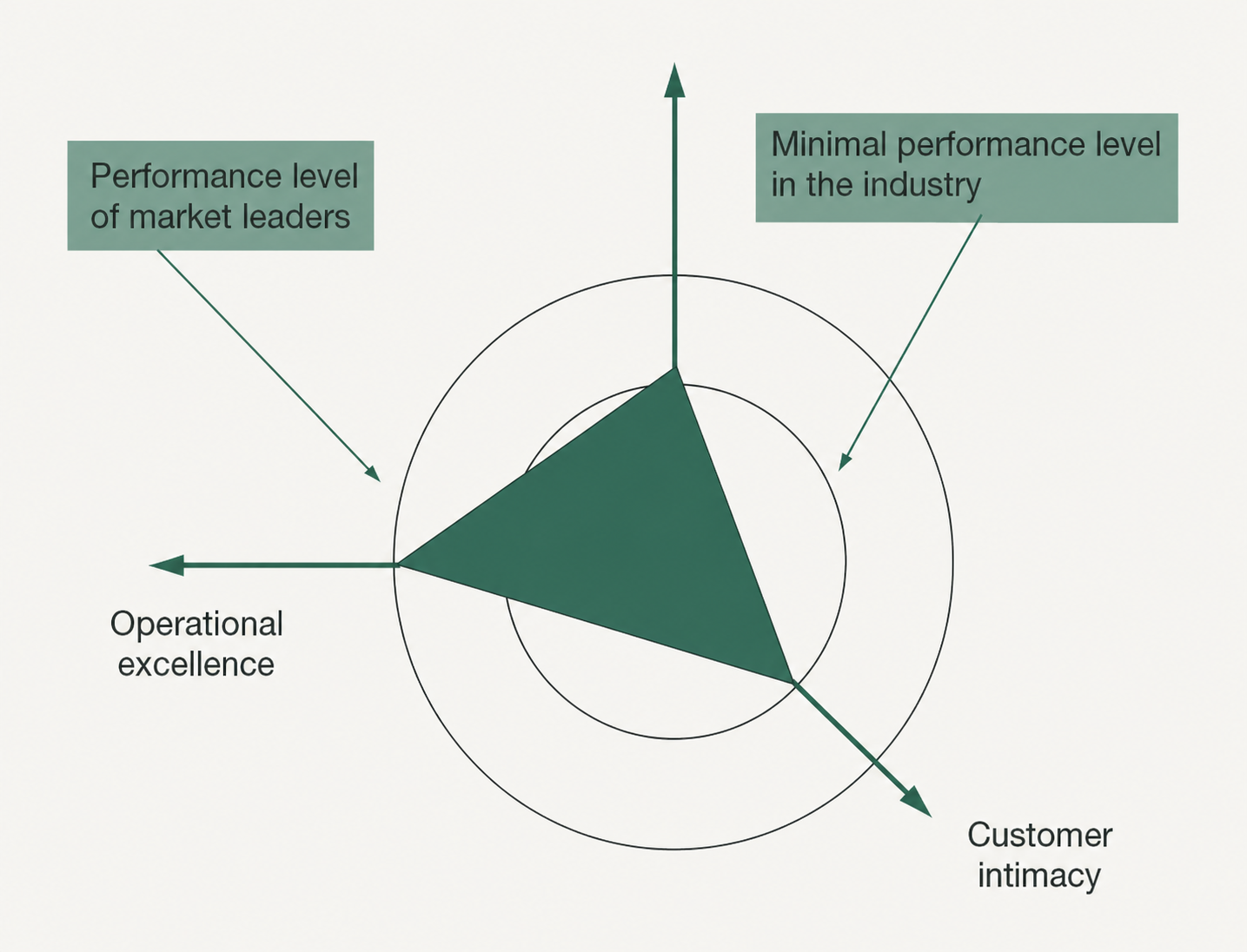
The value disciplines

How to use it

Run three rounds of strategic discussion.

In the first round, examine customers and competitors. Determine which kind of value matters most to current and desired customers, how needs vary by segment, what the market’s minimum standards are and where competitors perform better or worse.

In the second round, translate each discipline into a plausible operating model for the organisation:

  • An operational-excellence option emphasises reliable quality, low total cost, streamlined processes, integrated supply, low inventory, limited frills and volume economics. Standard modules and repeatable work are central.
  • A product-leadership option emphasises research, design, experimentation, rapid commercialisation and life-cycle management. A portfolio of trials is needed because a few major successes must fund many failures.
  • A customer-intimacy option emphasises selected long-term relationships, insight, responsiveness, reliability, retention and customer lifetime value. Tailoring must be reserved for relationships where the economics support it.

In the third round, develop the options in detail. Involve strong internal operators as well as senior leaders. For each discipline, specify required changes to processes, structure, culture, systems, technology and capabilities; estimate investment, revenue potential and financial feasibility; and identify success factors and risks. Senior management then chooses the primary discipline and makes the supporting trade-offs explicit.

Final analysis

Do not interpret the model as permission to excel in one dimension while performing badly in the others. Customers expect a rising threshold of quality, convenience and responsiveness. A distinctive discipline determines where the organisation leads, not what it is allowed to neglect.

Nor is the framework a universal classification. Some industries effectively require operational excellence or product leadership simply to participate, and strategic options such as sustainability, ecosystem control, make-or-buy choices or corporate branding sit outside the three categories. Large organisations may also operate different disciplines in different businesses.

Use the model as a way to expose alignment and trade-offs, alongside market, capability and corporate-strategy analysis. Customer value matters, but an organisation must also protect and develop the competencies that allow it to deliver that value over time.

Top practical tip

Describe what each discipline would require from the operating model before choosing one. The strongest option is not the most attractive slogan; it is the promise that fits valuable customer needs and can be supported by a coherent system.

Top pitfall

Do not force a single discipline across every business or ignore minimum expectations in the other dimensions. Treat the categories as strategic lenses, test them against evidence and revisit the choice as markets and capabilities evolve.

Further reading

Treacy, M. and Wiersema, F. (1997) The Discipline of Market Leaders: Choose Your Customers, Narrow Your Focus, Dominate Your Market. London: HarperCollins.