 keymodels
Distinctive capabilities (Kay)
How can distinctive capabilities (kay) support strategic choice or positioning?
Contents
John Kay is very much of the resource-based school. He believes that ‘the success of corporations is based on those of their capabilities that are.
John Kay’s resource-based view starts with a simple claim: corporate success rests on capabilities that are genuinely distinctive, not merely on assets or activities every competitor can reproduce.
When to use it
Use the model in corporate or business strategy to identify capabilities that can produce defensible value and deserve focused investment.
Origins
The concept belongs to the resource-based tradition of strategy, which explains performance through firm-specific resources, routines and relationships. John Kay developed his account in Foundations of Corporate Success, distinguishing three principal sources of advantage—architecture, reputation and innovation—and adding two tests: the capability must endure and the firm must be able to capture the return it creates.
What it is
Ask whether the organisation’s reputation, relationship network or capacity to innovate confers an advantage competitors cannot readily copy.
For Kay, strategy means identifying the firm’s capabilities, combining them with complementary assets and defending the resulting economic return. A valuable capability is necessary but not sufficient. It must also be:
- Sustainable—durable and defensible as competitors respond.
- Appropriable—the resulting value accrues substantially to the firm rather than leaking entirely to employees, suppliers, partners or customers.
Kay identifies three main sources:
- Innovation.
- Product, process or production innovation creates advantage when the firm can repeat it, protect it and capture its benefit. One isolated invention is not automatically a capability.
- Architecture.
- The internal and external network of relationships among employees, managers, customers, suppliers, alliance partners, government and even competitors. Strong architecture enables ordinary people to coordinate and perform unusually well.
- Reputation.
- Trust built through repeated delivery. Reputation can reduce customer uncertainty, support repeat business and justify a premium, but only while the organisation continues to earn it.
Distinctive capabilities
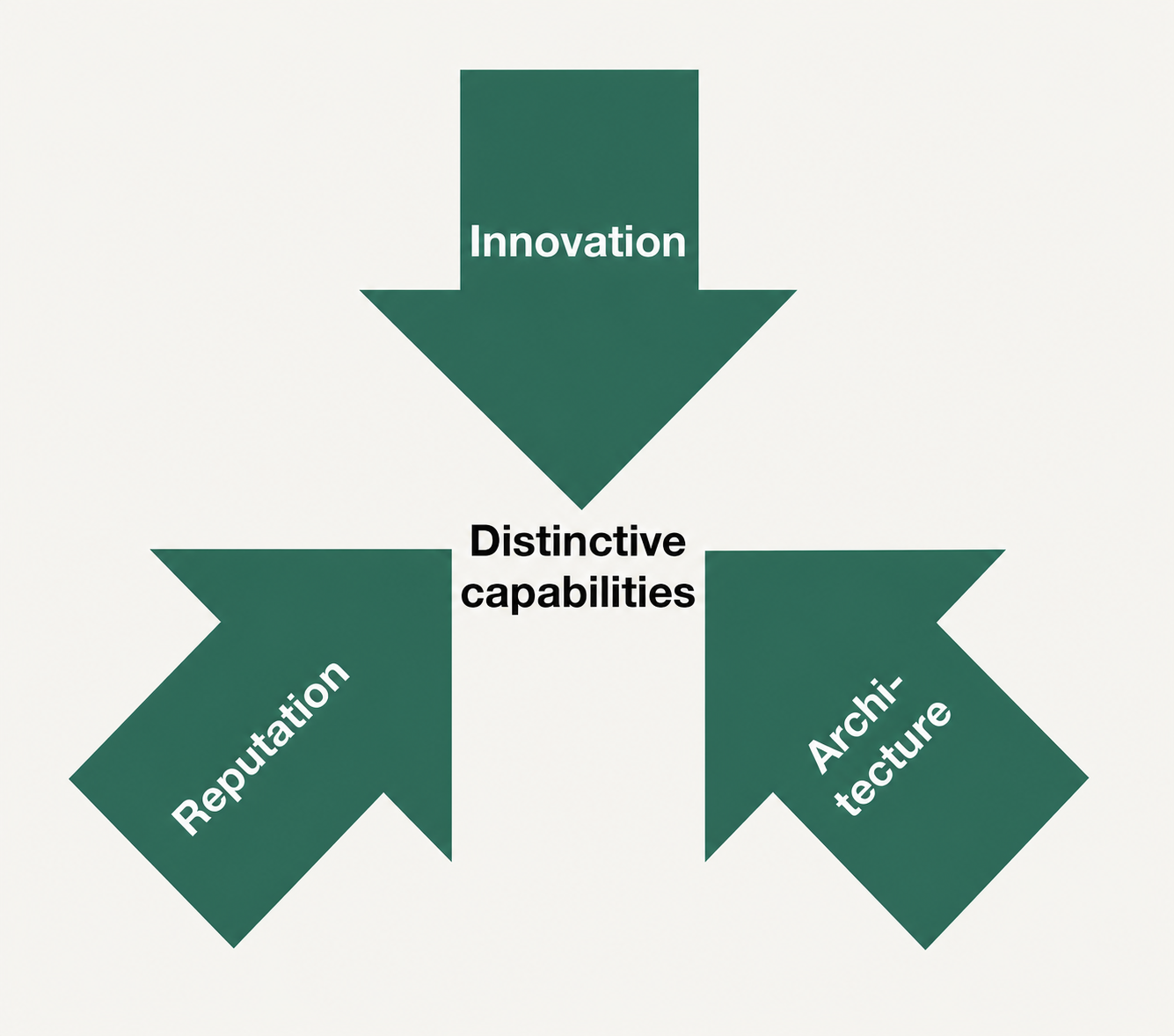
Examples include embedded skills and processes, knowledge routines, intellectual property, customer and supplier relationships, image and brand. Their value comes from the system they form and the market they serve.
Some required capabilities may be irreproducible because of history, industry structure or what Jay Barney calls causal ambiguity; see Strategically distinctive resources. When a market demands capabilities the firm cannot credibly build or access, strategy may be stronger when it selects arenas that fit existing distinction rather than chasing an aspirational list.
Continue your preview
Read more of Distinctive capabilities (Kay).
Create a free account to continue this advanced article preview. Complete access is available with Pro or an eligible outcome pack, so you can see the value before deciding to upgrade.