 keymodels
Beating the commodity trap (d’Aveni)
How can beating the commodity trap (d’aveni) support strategic choice or positioning?
Contents
What he calls the ‘commodity trap’ is when a previously leading player in an industry sees its competitive position so eroded it can no longer command a.
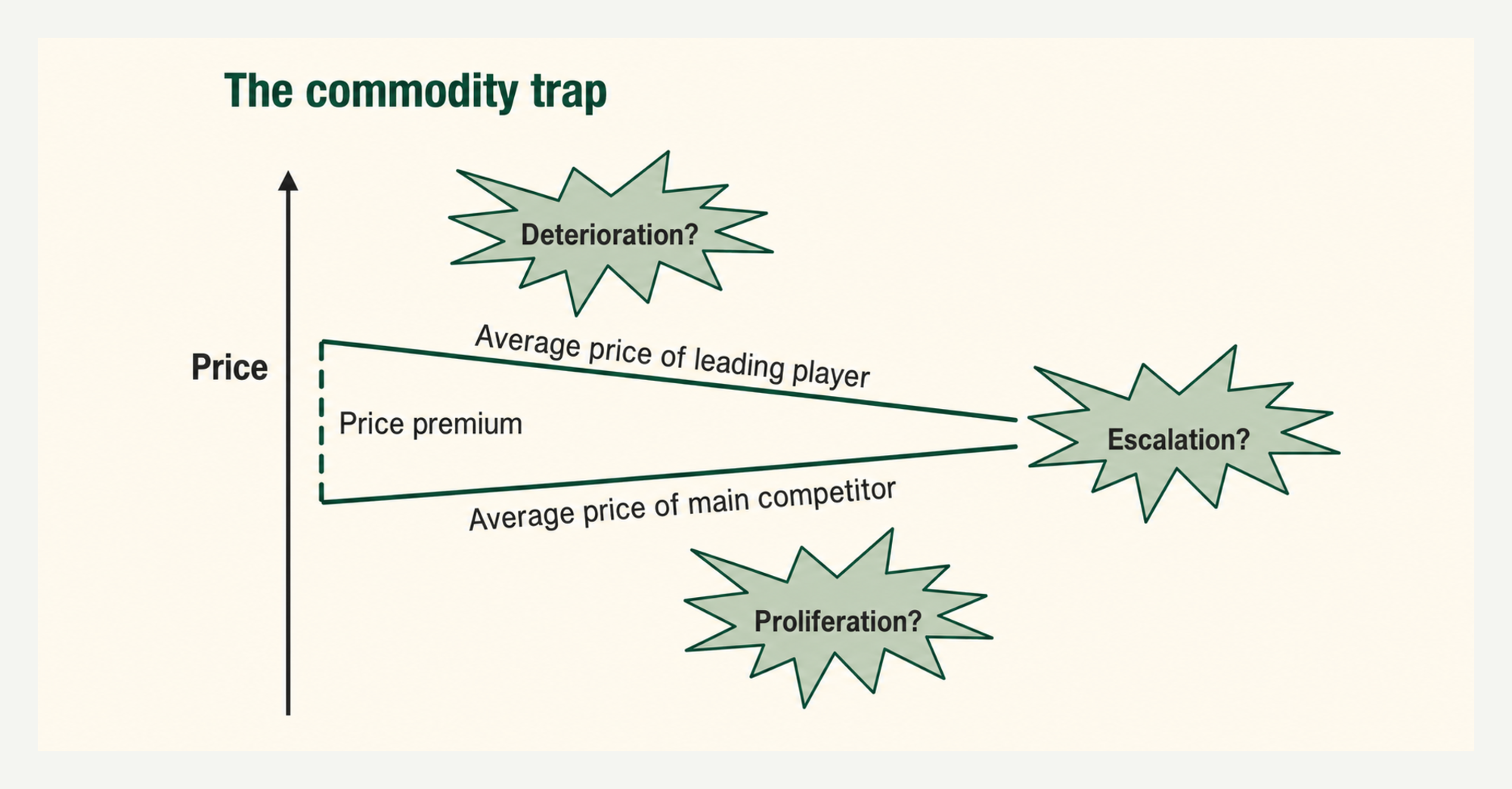
Richard D’Aveni’s “commodity trap” describes the point at which a former industry leader’s differentiation has eroded so far that customers no longer accept a price premium.
When to use it
To recognise and counter the threat of commoditisation in any industry; as D’Aveni emphasises, the process is not confined to literal commodities.
Origins
Strategy professor Richard A. D’Aveni developed this framework from research across thirty industries and presented it in his twenty ten book Beating the Commodity Trap. Building on his earlier work on hypercompetition, he distinguished three patterns through which once-differentiated offers become interchangeable in customers’ eyes: deterioration, proliferation and escalation.
What it is
Keith Richards once described the danger of believing oneself special and then being brought abruptly back to reality. Companies face the same risk when they assume their differentiation is permanent.
Ask whether the business truly offers something customers experience as distinctive. A competitor may already provide the same result—or one close enough that the difference is irrelevant—at a lower price.
Consider whether more low-cost rivals could enter, whether competition could accelerate and whether the category could become commoditised. D’Aveni’s warning is deliberately stark: over time, every source of differentiation is vulnerable to imitation or substitution.
Managers often recognise commoditisation late. Their instinctive response is then to discount formerly premium offers, which can deepen the problem by teaching customers that the distinction was never worth the price. A company already in a hole may, in effect, keep digging.
Conventional responses include reducing cost and capacity while defending margin, or differentiating further to preserve a premium position. D’Aveni argues that neither prescription is universally correct: the response must match the mechanism producing commoditisation.
His 30-industry study identifies three root causes:
- Deterioration.
- Competitors enter with lower-price or lower-benefit offers that attract the mass market, as Zara did when challenging high-end fashion companies.
- Proliferation.
- Rivals create many new combinations of price and distinctive benefit, each attacking part of an incumbent’s position, as Japanese and American motorcycle manufacturers did to Harley-Davidson.
- Escalation.
- Entrants provide more benefits for the same or a lower price and compress margins throughout the category, as the iPhone did in mobile phones.
Diagnosis comes first: once the root mechanism is known, the company can avoid it, remove it or potentially turn it to its advantage.
The commodity trap
Continue your preview
Read more of Beating the commodity trap (d’Aveni).
Create a free account to continue this advanced article preview. Complete access is available with Pro or an eligible outcome pack, so you can see the value before deciding to upgrade.