 keymodels
Service profit chain
How should service profit chain be measured and interpreted?
Contents
Connect employee satisfaction and performance with company profits.
The service profit chain proposes that internal service quality supports employee capability and engagement; those conditions improve service value; customer satisfaction can strengthen loyalty; and loyalty can contribute to revenue growth and profit. It does not add a mysterious fourth source of profit beyond revenue and cost. It explains one causal route through which those economics may improve.
Historical examples made the idea memorable. Southwest Airlines associated its culture with Herb Kelleher’s leadership and service values, but culture is created by systems and many people, not a CEO alone. The claim that the airline never made a loss across 50 years should be treated as dated promotional context, not a current fact about its 50, employees.
A Taco Bell analysis reported that the 20 per cent of stores with the lowest employee turnover produced twice the sales and 55 per cent higher profits than the 20 per cent with the highest turnover. The association is striking but does not by itself prove that reducing turnover caused the difference.
Customer satisfaction and loyalty are also non-linear. In historical Rank Xerox research using a five-point scale, 5 was high and 1 low. Customers rating satisfaction 4 out of 5 differed from those rating it 5 out of 5; those awarding 5 were reported as six times more likely to repurchase than those awarding 4. James Heskett argued that averages above 4 out of 5 may be required for strong loyalty. The exact relationship should be validated for the organisation and segment.
When to use it
- Map hypotheses linking employee conditions, delivered service, customer behaviour and economics.
- Diagnose where the chain is breaking rather than assuming all links are equally strong.
- Design a balanced measurement and improvement programme for service organisations.
Origins
James Heskett and colleagues introduced the service-profit-chain framework in a 1994 Harvard Business Review article, “Putting the Service-Profit Chain to Work.” They expanded it in the 1997 book The Service Profit Chain: How Leading Companies Link Profit and Growth to Loyalty, Satisfaction and Value.
What it is
Developments of the model
The model can be used in organisations of any size and is especially visible where employees interact directly with customers, such as retail, airlines and leisure. In other settings, internal technology, process and product reliability may mediate the relationship.
Treat each arrow as a testable hypothesis:
- internal quality → employee capability, satisfaction and retention;
- employee conditions → service productivity and value;
- service value → customer satisfaction;
- satisfaction → loyalty or desired behaviour; and
- customer behaviour → revenue, margin and profit.
A revenue-at-risk analysis can combine satisfaction and likelihood-to-recommend data to identify vulnerable accounts. In one engineering-company example, one-third of customers appeared likely to remain loyal and 20 per cent appeared at risk.
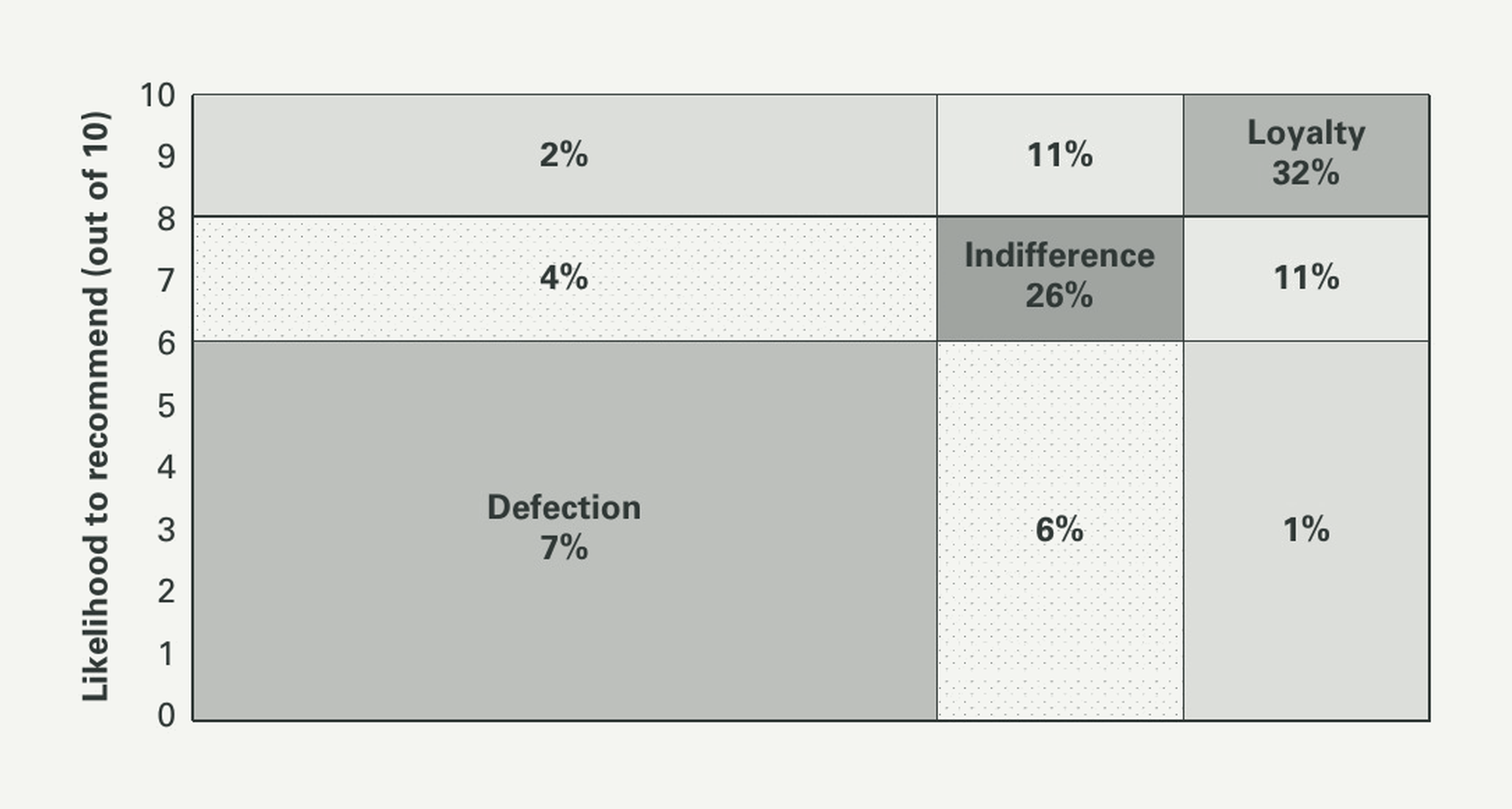
The analysis is a prioritisation device, not proof of individual intent. Use account evidence, behaviour and direct conversation before intervening.
Continue your preview
Read more of Service profit chain.
Create a free account to continue this advanced article preview. Complete access is available with Pro or an eligible outcome pack, so you can see the value before deciding to upgrade.