
Balanced scorecard
How should balanced scorecard be measured and interpreted?
Contents
The balanced scorecard (BSC) was developed by Kaplan and Norton in 1992 as an alternative to traditional performance measurement approaches that focus solely on.
The balanced scorecard (BSC), introduced by Robert Kaplan and David Norton in 1992, broadened performance management beyond financial indicators that describe only past results. It translates an organisation’s mission, vision and strategy into objectives monitored across four perspectives. Relevant key performance indicators (KPIs) in each perspective make the long-term direction more concrete, allowing management to track execution and take corrective action promptly.
When to use it
Use the BSC when traditional financial reporting is too narrow to manage strategy. It complements financial outcomes with the non-financial drivers of future success across financial, internal business processes, learning and growth and customer perspectives. The scorecard asks:
- Which outcomes matter to shareholders?
- How do customers experience and perceive the organisation?
- Which internal processes create the greatest value?
- Does the organisation have the learning and innovation capacity required for the future?
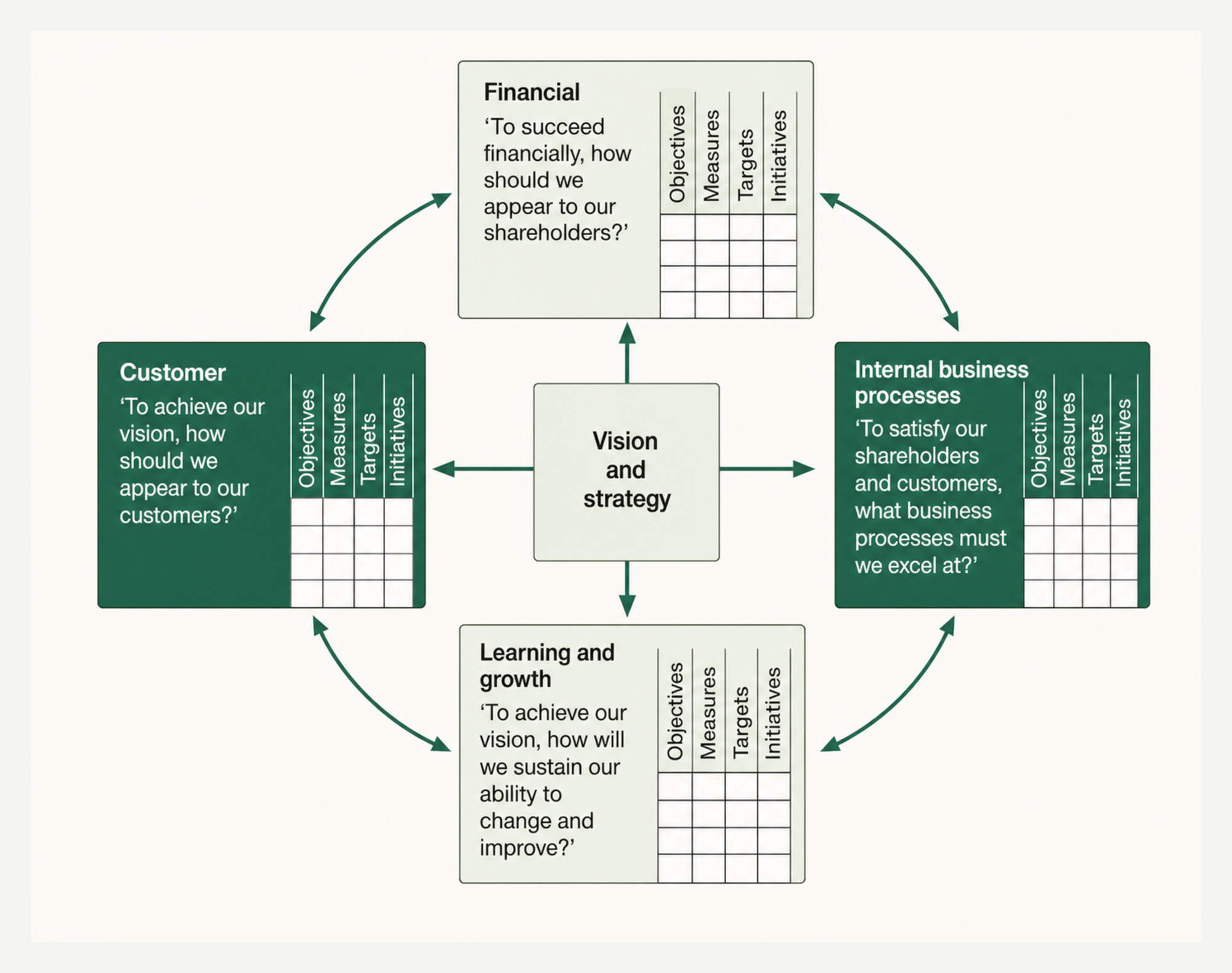
The scorecard combines lagging indicators of past performance with current operating measures and leading indicators of future readiness. A transparent, multidimensional view helps managers see where execution is diverging from strategy and intervene in time to support durable performance improvement.
Origins
Kaplan and Norton developed the BSC through a multi-company research project and introduced it in their 1992 Harvard Business Review article “The Balanced Scorecard—Measures That Drive Performance.” Their work built on earlier performance dashboards, including the French tableau de bord, and on a corporate scorecard created at Analog Devices by Art Schneiderman. Kaplan and Norton subsequently expanded the concept from measurement into a system for translating and executing strategy.
What it is
The BSC expresses strategy as a connected set of objectives and measures across four perspectives: financial, customer, internal process, and learning and growth. Its logic is causal: people, information and capabilities enable stronger processes; stronger processes improve customer outcomes; and customer outcomes contribute to the intended financial results. A genuine scorecard is therefore a strategic hypothesis expressed through measures, not a collection of unrelated KPIs.
How to use it
Begin by clarifying mission and vision. These define the desired performance and guide the choice of strategic objectives, success factors and KPIs in each perspective:
- Financial perspective. Provide managers with timely, accurate evidence of economic performance. Return on investment (ROI) and economic value added are common measures, but the appropriate set depends on the company and industry.
- Customer perspective. Track whether the organisation is delivering value that customers recognise. Satisfaction, retention, market share and account share reveal important aspects of perception and behaviour. Other measures may include customer profitability, returns, service-call handling, target-segment share, claims and complaint resolution.
- Internal process. Monitor the operations that deliver the customer and financial outcomes. Relevant indicators can cover quality, responsiveness, cycle time, cost, product development, time to market, time to break even and new-product sales as a share of total revenue.
- Learning and growth. Assess whether people, knowledge, information and innovation systems can sustain improvement. Measures may include employee satisfaction, retention, revenue or value added per employee, depth of critical skills, ideas generated per employee and information availability relative to need.
Do’s
- Use the BSC to articulate and communicate strategy, then align individual, departmental and organisation-wide initiatives around common outcomes.
- Review the scorecard often enough to ensure that its objectives and measures still represent the strategy.
Don’ts
- Do not reduce the BSC to behavioural control or retrospective evaluation.
Final analysis
Non-financial measurement existed before Kaplan and Norton, but their 1992 work made the case for combining perspectives into one coherent management system. Senior leaders often default to financial outcomes; the BSC makes the drivers of those outcomes visible and gives the organisation a shared set of strategic measures.
Choosing a genuinely balanced set is difficult. A senior-management scorecard of roughly 12–16 indicators can work when the leadership team agrees on their meaning and priority. Those headline measures must also cascade into operational indicators that middle managers and frontline teams can influence. Without that translation, employees may see only high-level goals over which they have little control.
Update the scorecard at a cadence suited to the business so that obsolete assumptions do not turn yesterday’s measures into today’s distractions.
Top practical tip
Start with the strategy and its cause-and-effect logic, then choose measures. Every KPI should indicate either a desired outcome or a driver that management believes will produce it.
Top pitfall
Avoid turning the scorecard into a KPI catalogue. Too many disconnected measures obscure priorities, encourage local optimisation and prevent the organisation from testing whether its strategic hypothesis is working.
Further reading
Kaplan, R. and Norton, D. (1992) ‘The Balanced Scorecard: Measures that drive performance’. Harvard Business Review Jan–Feb, 71–80.
Kaplan, R. and Norton, D. (1996) The Balanced Scorecard: Translating Strategy into Action. Cambridge MA: Harvard Business School Press.