 keymodels
Risk–reward analysis
How can risk–reward analysis support strategic choice or positioning?
Contents
The risk–reward analysis charts potential rewards of strategic options against the associated risk.
Risk–reward analysis compares the potential value of strategic options with the uncertainty and downside attached to them. Plotting options on a common view helps leaders decide where to investigate, redesign, sequence or allocate resources. It is inspired by risk–return reasoning in finance but must be adapted carefully for non-traded strategic choices.
When to use it
Use the analysis when several materially different initiatives compete for capital, capacity or management attention. It can support a rapid executive discussion or a detailed process involving market research, return-on-investment estimates, scenarios and sensitivity analysis.
Apply it to individual options and portfolios. A combination may diversify exposure, create dependency or concentrate risk; the simple chart does not model those interactions automatically. Use portfolio scenarios when the options share customers, technology, cash, suppliers or execution resources.
Origins
The method draws from investment portfolio theory, capital budgeting and strategic portfolio analysis. Financial risk–return models compare expected return with the distribution of possible outcomes; managers later adopted similar maps for projects and strategic options. No single canonical origin or formula governs the generic risk–reward chart.
What it is
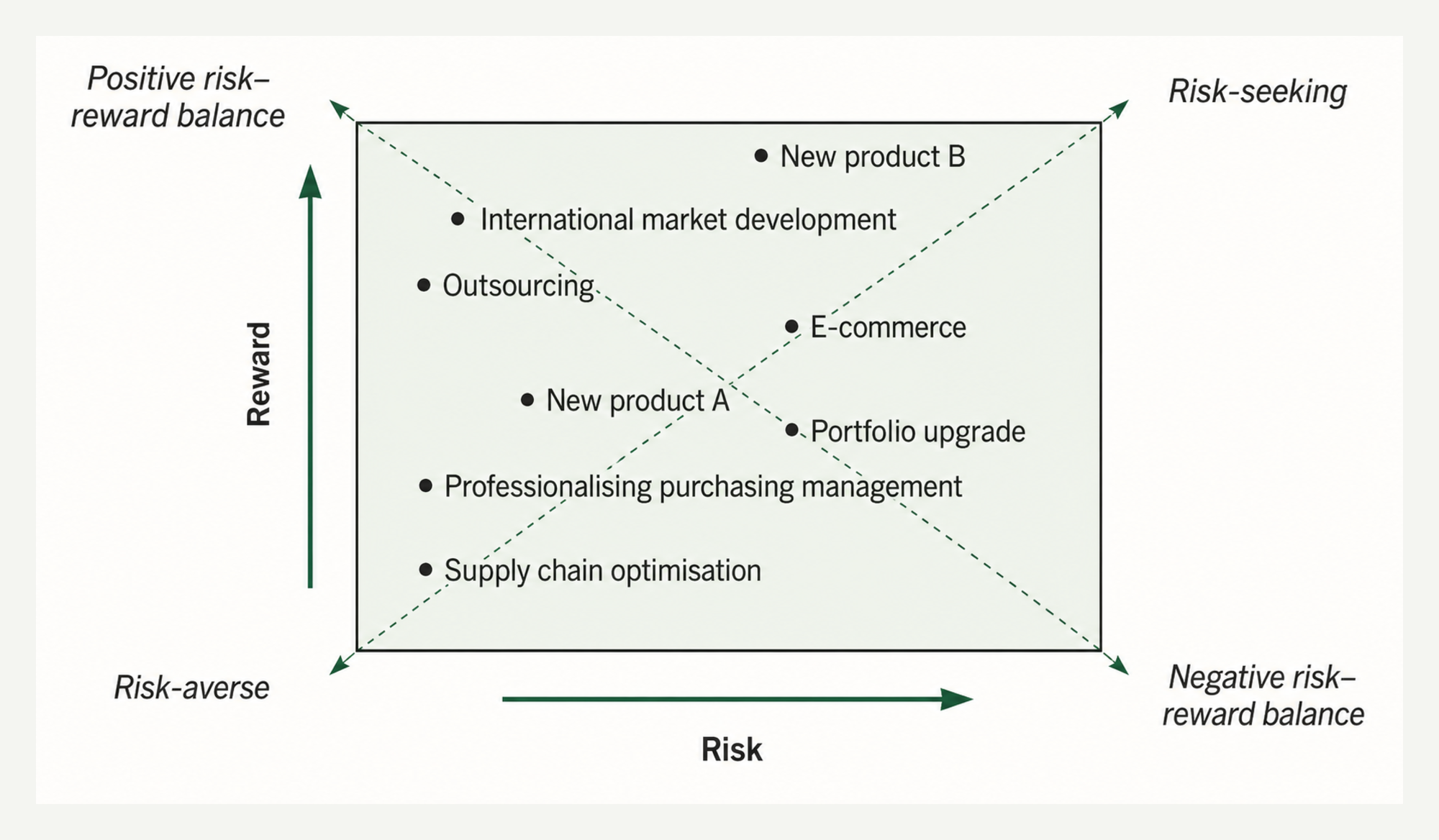
Each option is positioned by a defined reward measure and a defined risk measure. A third visual dimension may represent resource requirement, while colour or shape can show horizon, strategic theme or confidence. The apparent simplicity depends on transparent definitions beneath every point.
Continue your preview
Read more of Risk–reward analysis.
Create a free account to continue this advanced article preview. Complete access is available with Pro or an eligible outcome pack, so you can see the value before deciding to upgrade.