
Value stream mapping
How can value stream mapping improve people, teams, or organisational effectiveness?
Contents
Lean thinking (Lean thinking/just-in-time) focuses on adding value for customers and eliminating non-value-adding steps (waste).
Value stream mapping is a lean method for visualising the material and information required to deliver a product or service. By showing value-adding work, waiting, inventory, rework and control signals in one end-to-end view, it helps a team design better flow rather than optimise isolated steps.
When to use it
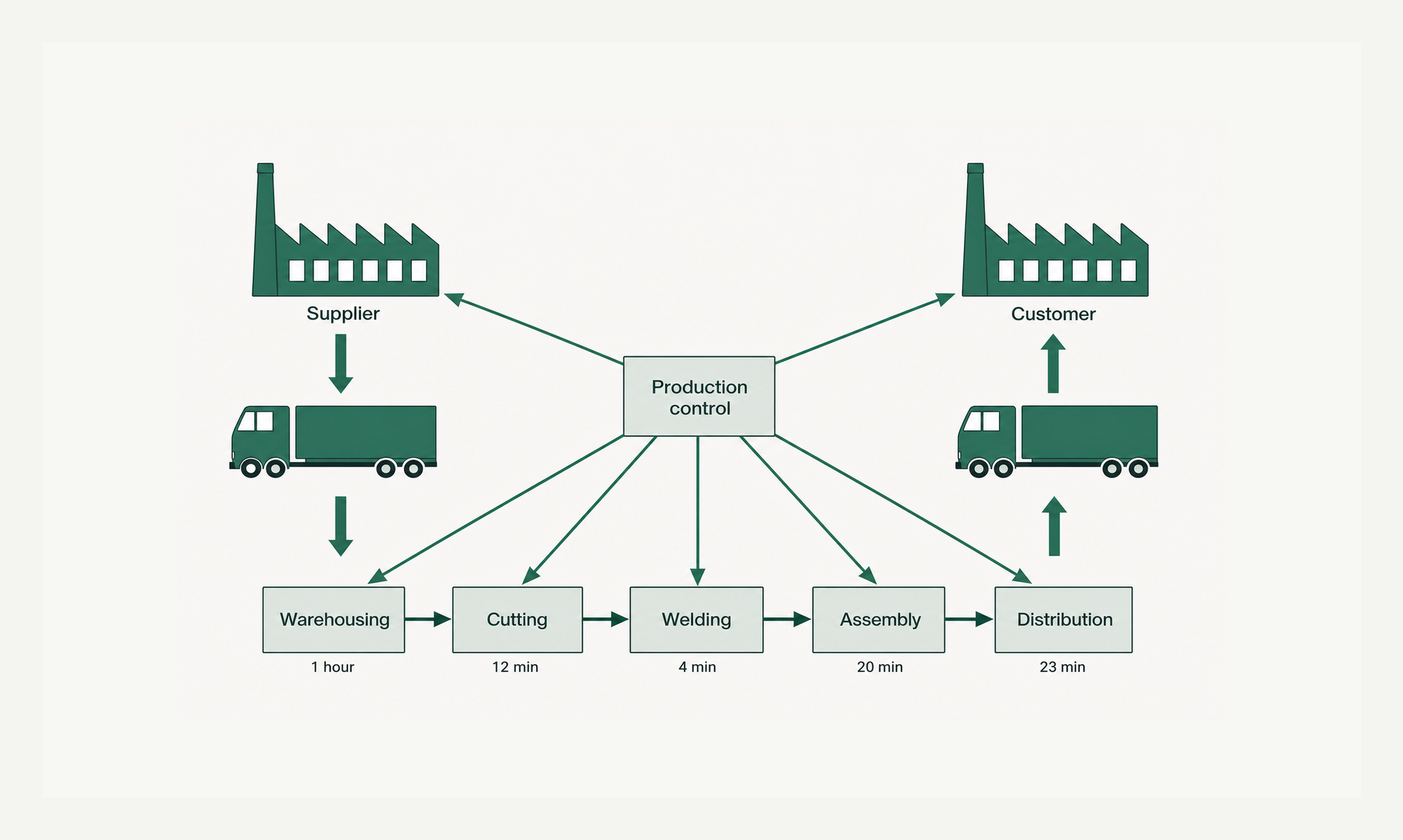
Use value stream mapping to reduce lead time, expose waste and coordinate improvement across functional boundaries. A map records process steps, material movement, information flow and operating data such as inventory, cycle time and batch size with common symbols (see Rother and Shook, 2003). The current-state map supplies evidence for designing a leaner future state.
Origins
The practice grew from Toyota’s material-and-information-flow diagrams within the Toyota Production System. Those diagrams connected physical production with the information that triggered it, making queues and disconnected control visible. Mike Rother and John Shook adapted the method for a wider lean audience in Learning to See, first published in the late nineteen nineties. Its sequence of current state, future state and implementation plan became the standard approach.
What it is
A value stream includes every action and signal needed to move one product or service family from request to delivery. The team walks the real flow, records observed data and draws how work currently moves. It then designs a feasible future state with less waiting, inventory and rework, better pull and a clearer relationship to customer demand.
Unlike a conventional process chart, the map combines work and information at a level broad enough to reveal system behaviour. It makes visible how scheduling, batches, handoffs and local incentives create delay even when individual activities appear efficient.
How to use it
The first stage is the current-state map. Select a product or service family, observe the flow directly and record cycle time, waiting, changeover, work in progress, defects, staffing and information signals. Distinguish customer-valued transformation from necessary support and avoidable waste.
The second stage is the future-state map. Begin with customer demand and ask what takt time is required, where continuous flow is possible and where a pull system should control replenishment. Design for flexibility as well as efficiency; a brittle ideal state will fail when volume or mix changes.
The third stage is implementation. Convert the gap into manageable improvement loops with owners, timing, measures and sponsorship. After changes stabilise, draw the state again and continue the cycle.
A practical sequence is:
- Select the product or service family and assemble people who own and perform work across the stream.
- Walk the process and draw a high-level current flow.
- Add reliable data on throughput, time, inventory, quality and staffing.
- Design an ideal direction based on customer demand, low work in progress, short setup and the improvements needed to approach it.
- Create a prioritised action plan with accountable owners, milestones and sponsors.
- Monitor results and return to step 1 with an updated current state.
Final analysis
The method is not only about removing visible waste. It also reduces variability, levels utilisation and aligns output with what customers actually require. That makes customer demand the starting point, not an afterthought.
Data may be missing, particularly in administrative or service work mapped for the first time. Collecting it takes effort but is preferable to filling a visually polished map with assumptions. Use representative observation and make uncertainty explicit.
The future state also changes routines and behaviour. Standard work limits improvisation inside the process so that initiative can be redirected toward improving the process itself. People affected by that change need to help design it and understand the reason for the new method.
A map creates no value until action follows. Without owners, experiments, measures and reinforcement, the organisation will regress to the old flow and the mapping exercise itself becomes waste.
Top practical tip
Choose one product or service family and walk its entire path with the people who do the work. Use observed times and queues, then select a small future-state loop that can be implemented and measured quickly.
Top pitfall
Do not stop at a beautifully drawn future state. If the plan lacks accountable owners, behavioural changes, milestones and follow-up, the process will revert and the mapping effort will have added no value.
Further reading
Rother, M. and Shook, J. (2003) Learning to See: Value Stream Mapping to Add Value and Eliminate Muda. Cambridge, MA: Lean Enterprise Institute.