
keymodels
Menu
InnovationKPI / metricModelAccessible

Strategic IT-alignment model

How should strategic it-alignment model be measured and interpreted?

AccessibleStrategicProgram / project2 min read
Contents

Henderson and Venkatraman’s framework for aligning business and IT strategy with organisational and technology infrastructure.

Henderson and Venkatraman’s Strategic Alignment Model links business strategy, IT strategy, organisational infrastructure and IT infrastructure. It helps leaders examine whether technology choices support the business and whether emerging technology should reshape the strategy. The framework is organised around two dimensions: strategic fit and functional integration.

When to use it

Apply the model when technology is material to delivering or changing the business strategy. IT strategy should not be designed or altered in isolation; alignment must be managed across external choices and internal operating arrangements.

The framework helps an organisation:

  1. make the connection between business strategy and IT strategy explicit;
  2. recognise how technology and information systems can support or redirect strategic choices;
  3. improve the value created from IT across the company.

Origins

John C. Henderson and N. Venkatraman developed the Strategic Alignment Model through research begun in the late 1980s. Their work responded to information technology’s evolution from administrative support toward a potential source of strategic transformation. The model connects four domains through the concepts of strategic fit and functional integration.

What it is

  • Strategic fit – the consistency between external strategic positioning and the corresponding internal infrastructure and processes.
  • Functional integration – the connection between business choices and IT choices at both strategic and operational levels.

Together, the dimensions test two essential outcomes:

  1. IT and organisational arrangements should enable the business strategy.
  2. The IT infrastructure should fit the operational processes created by strategic choices.
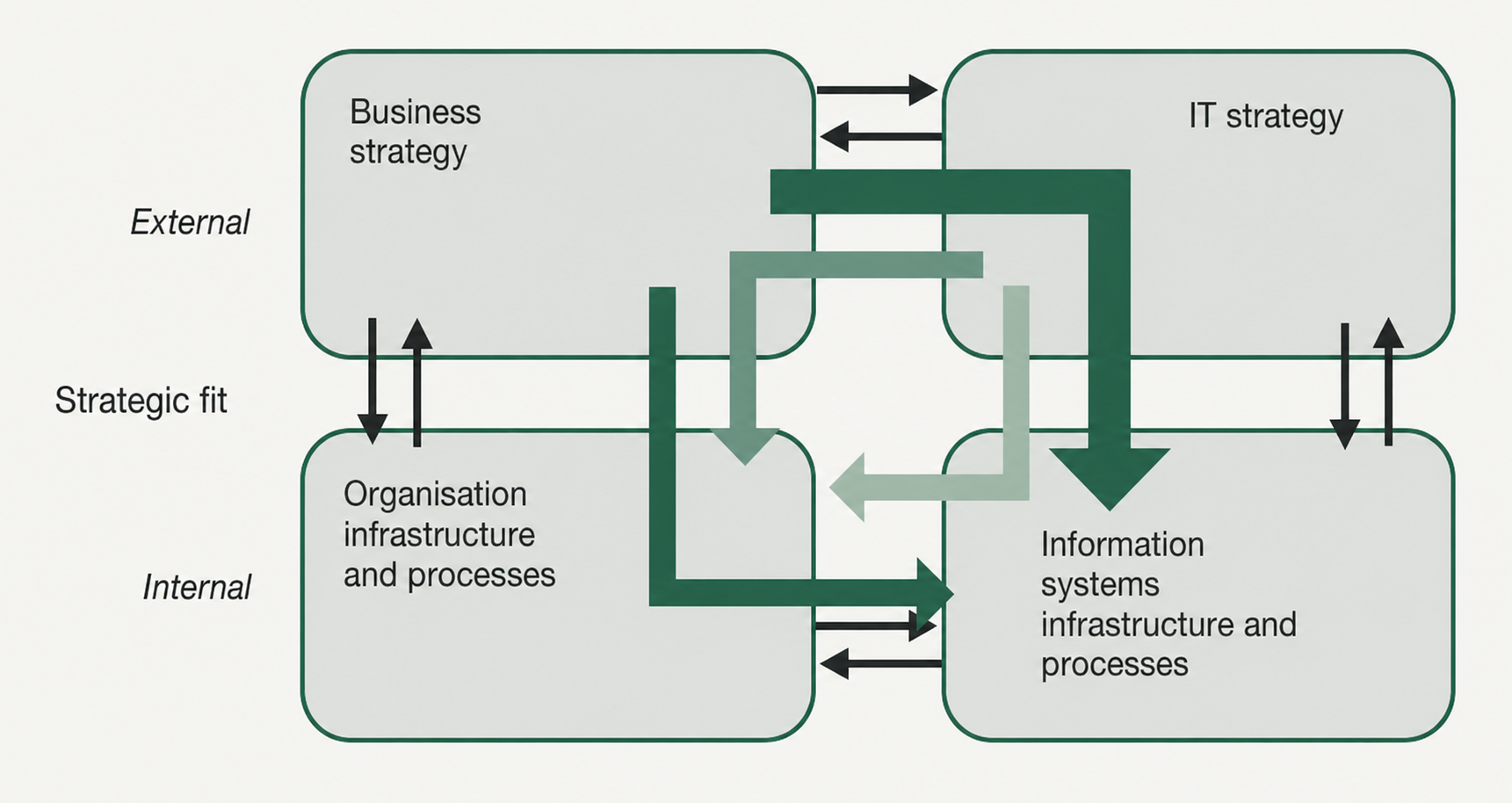
Strategic IT-alignment model

The framework does not assume that business strategy always acts first. It offers several directions of alignment, each assigning a different role to business leaders, technology leaders and infrastructure.

How to use it

Examine the four dominant perspectives represented by the arrows in the model.

Strategic development (the anti-clockwise arrow from top left)

This is the traditional hierarchy. Senior management defines the business strategy, which shapes the organisational structure and processes and then determines the required information-systems infrastructure. Strategy drives structure, and both provide the logic for technology implementation.

Technological potential (the clockwise arrow from top left)

Business strategy remains the starting point, but management translates its view of technology into a distinct IT strategy before specifying the internal IT architecture and processes. The external technology choices must fit the business strategy, and the implemented infrastructure must in turn remain consistent with the IT strategy.

Competitive potential (the anti-clockwise arrow from top right)

Here, technology capabilities can alter business strategy. Emerging IT may enable new products and services, new relationship structures or new forms of control and coordination. Technology leaders interpret developments as strategic opportunities and threats, while senior management decides how those possibilities should change the business direction and organisational design.

Service level (the clockwise arrow from top right)

The IT strategy drives a service-oriented technology infrastructure, which then shapes organisational processes. Business strategy is less visible in this route. The danger is an internally optimised technology environment that requires large spending on platforms, acquisitions or licences without a strong business-value discipline. Senior management must therefore remain accountable for resource allocation and service outcomes.

Final analysis

The model correctly places business and IT strategy within senior leadership’s responsibility. In practice, executives often delegate technology strategy to specialists and then review projects only as technical investments. Alignment cannot be solved by a diagram alone: it requires shared governance, business capability ownership, architectural decisions and measures of value. Use the perspectives to expose which domain is driving change and where an unsupported assumption or missing conversation breaks the chain.

Top practical tip

For every major technology initiative, state the business capability it changes, the strategic assumption it supports and the operating process that must adapt.

Top pitfall

Do not delegate alignment to the IT function. Technical expertise cannot decide the organisation’s strategy, risk appetite or investment priorities on behalf of top management.

Further reading

Henderson, J.C. and Venkatraman, N. (1991) ‘Understanding strategic alignment’. Business Quarterly 55(3), 72.

Henderson, J.C. and Venkatraman, N. (1993) ‘Strategic alignment: leveraging information technology for transforming organisations’. IBM Systems Journal 32(1), 4–16.