 keymodels
Internationalisation strategy framework
How should internationalisation strategy framework be measured and interpreted?
Contents
Doing business on an international level requires both thinking about the (new) markets the company is active in or about to enter, and the coordination and synergies.
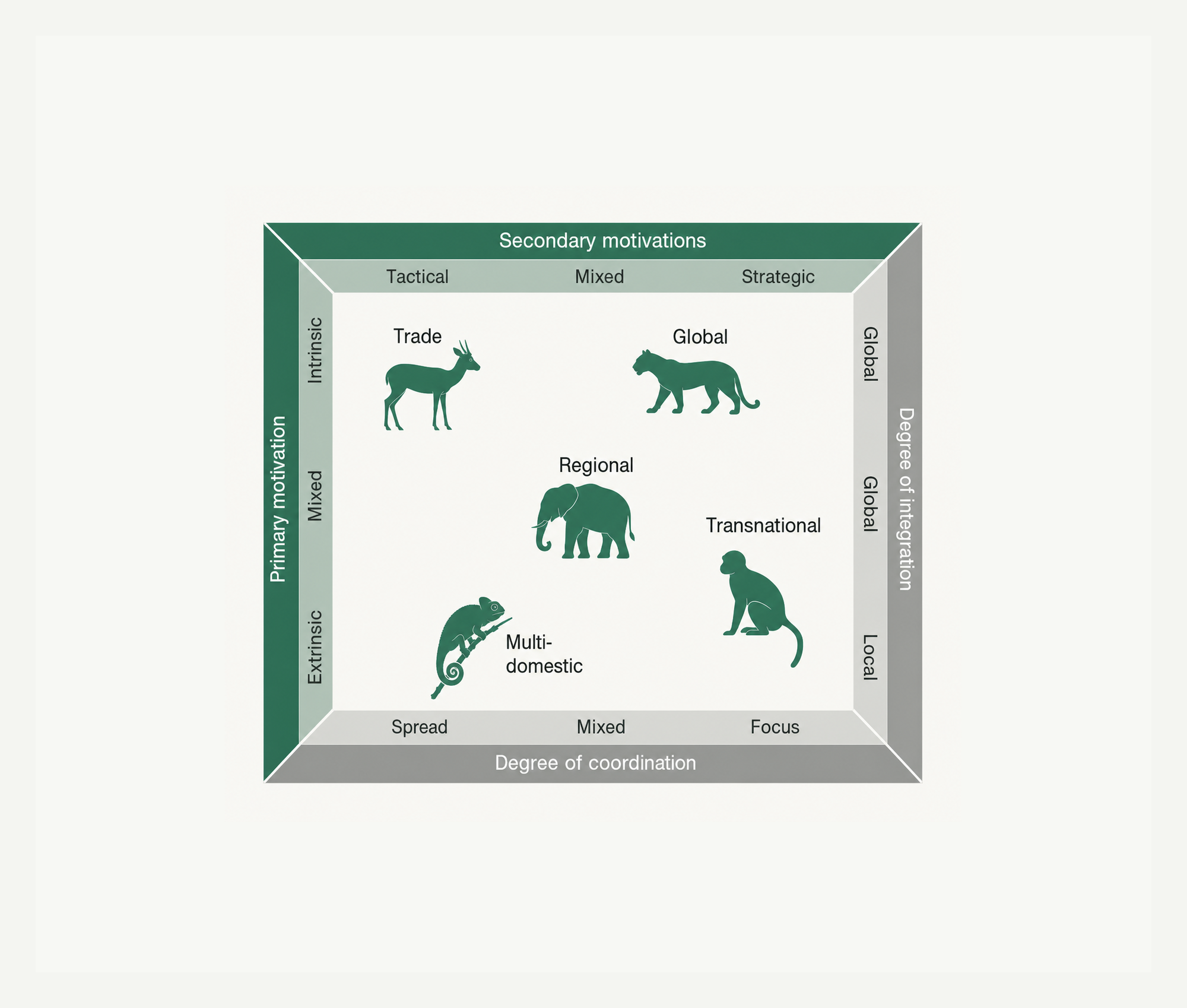
The internationalisation strategy framework helps an organisation balance global integration, regional coordination and local responsiveness when entering or reorganising foreign markets. It links the reason for expansion with the spread and governance of activities.
When to use it
Use the framework before entering a country, when selecting an operating model after entry or when rationalising a historically accumulated international footprint. It offers five patterns:
- Trade model.
- Pursue short-term matches between available offers and local opportunities through import, export or agents. Commitment and coordination are low, but durable advantage and local relationships may remain weak.
- Multi-domestic model.
- Adapt offers and operations to each country. Local responsiveness and embeddedness are strong, while scale and cross-country coordination are harder.
- Global model.
- Standardise an offer and integrate activities around headquarters-led advantage. Efficiency can be high, but poor local fit can cause failure.
- Regional model.
- Cluster sales, production or support across related countries. This can balance scale and proximity, although power and coordination between regions require design.
- Transnational model.
- Combine global efficiency, local responsiveness and cross-border learning. It can create substantial value but demands strong coordination, investment and shared capability.
Origins
The framework belongs to research on global integration and local responsiveness. C.K. Prahalad and Yves Doz articulated that tension, while Christopher Bartlett and Sumantra Ghoshal distinguished multinational, global, international and transnational forms. This five-model version is a practical synthesis that adds trade and regional configurations and was shaped partly for expansion into African markets.
What it is
- Why internationalise? Distinguish a country-specific opportunity from expansion based on transferable advantage, and tactical gain from a long-term competitive position.
- How should activities be organised? Decide which value-chain activities belong locally, regionally or globally and how decision rights, cost and accountability will be coordinated.
The answers reveal trade-offs among responsiveness, learning, control, scale, risk and reversibility.
Continue your preview
Read more of Internationalisation strategy framework.
Create a free account to continue this advanced article preview. Complete access is available with Pro or an eligible outcome pack, so you can see the value before deciding to upgrade.