keymodels
Menu
MarketingFramework / modelModelAccessible

Social network analysis

How can social network analysis improve people, teams, or organisational effectiveness?

AccessibleOperationalIndividual2 min read
Contents

A method for mapping relationships among people or organisations to understand reach, influence, information flow and structural vulnerability.

In a networked economy, organisational advantage can depend on relationships as well as internal knowledge. Social network analysis maps connections among employees and external stakeholders—such as contacts within a supplier—and represents them as nodes for actors and ties for relationships. The map helps managers see how information, resources and influence may move through the system.

When to use it

Use network analysis when the organisation needs to understand its reach, identify people who can mobilise support or locate relationships relevant to a product launch, commercial campaign or crowdsourcing exercise. The method produces a snapshot and can be complex and time-consuming, so define the decision and network boundary before collecting data. It is especially useful for identifying where relational strength is concentrated, which experts could be consulted and where dependence on a small number of people creates risk.
(Social) network analysis

Origins

Social network analysis draws on graph theory, sociology, psychology and anthropology. Jacob L. Moreno used sociometry and sociograms in the nineteen-thirties to represent interpersonal relationships. Anthropologist John A. Barnes later applied the term social network systematically in a study of a Norwegian community. Research at Manchester, Harvard and elsewhere developed methods for examining cliques, centrality and structure, while advances in computing established the field as an interdisciplinary analytical practice.

What it is

A network consists of nodes, representing people, teams, organisations or other actors, and ties, representing a defined relationship among them. Analysis can examine degree, density, centrality, brokerage, clusters and path length to understand how information, influence or resources may travel. A network may be directed or undirected and its ties may be weighted or unweighted. Every result depends on what counts as a node and a tie, so a contact, a trusted advice relationship and a contractual dependency should not be treated as equivalent.

How to use it

Build the analysis in stages:

  • Map the key internal players. Start with the organisation chart, then include influential contributors who may not hold formal authority.
  • Identify their important external contacts. Ask employees about relationships with customers, suppliers, competitors, unions, trade bodies and other relevant parties. Online connections can supplement this evidence where collection is lawful, ethical and meaningful.
  • Cluster contacts by strategic role. Useful themes may include information for knowledge and customer insight, resources for finance or funding, and status for people or institutions with which the organisation seeks association.
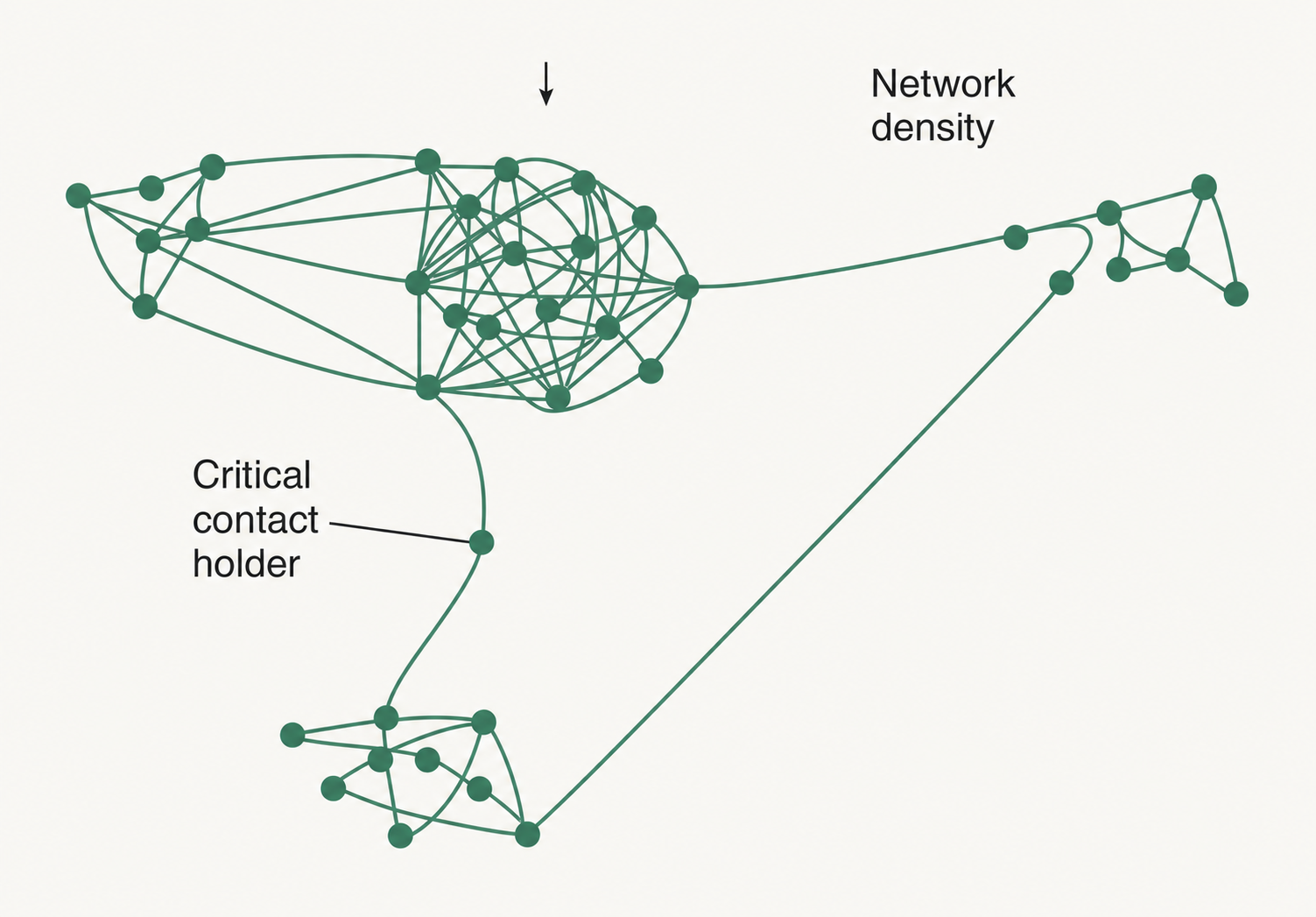
  • Assess network density. Numerous connected nodes can indicate strong embeddedness. A dense pattern may help information travel quickly and may support trust because members have several overlapping relationships. More than one organisational representative can improve continuity. Density alone, however, says nothing about the quality, relevance or direction of the ties.
  • Locate structural gaps. Identify areas where no relationship exists and ask whether bridging the gap would improve access, entrepreneurship or flexibility. Not every gap needs filling; some boundaries protect confidentiality or independence.
  • Find critical contact holders. Determine which employees connect the organisation with essential partners. Develop appropriate backup relationships so that one person’s departure does not sever a strategically important connection.
  • Organise network stewardship. Give named people responsibility for maintaining priority networks. Encourage them to bring knowledge into the organisation, discuss and share it rather than merely transmit it, support critical connectors and build bridges where the analysis shows a genuine need.

Final analysis

Most organisations do not maintain a reliable map of their relationships or the advantages and vulnerabilities those relationships create. Yet networks play an important role in contemporary business models and value creation, while digital platforms make parts of the relationship structure increasingly visible. A network map can therefore reveal opportunities that an organisation chart misses. It should still be treated as sensitive, time-bound evidence: obtain appropriate consent, avoid inferring relationship quality from a digital connection alone and update the map when the decision requires it.

Top practical tip

Define the relationship being mapped—advice, trust, information, influence or another tie—before collecting names. The definition determines what every measure means.

Top pitfall

Do not equate density with strength or scrape visible connections without context. A crowded map may contain weak, obsolete or irrelevant ties and can create serious privacy concerns.

Further reading

Burt, R.S. (2009) Social Capital: Reaching Out, Reaching In. Cheltenham: Elgar Publishing.