
keymodels
Menu
Organisational behaviourTheory / principleModelAccessible

Seven habits of highly effective people (Covey)

How can seven habits of highly effective people (covey) improve people, teams, or organisational effectiveness?

AccessibleOperationalIndividual2 min read
Contents

Wildly popular throughout the 1990s and into the twenty-first century, Stephen Covey (1989) has changed the face of many an ambitious manager’s bedside table.

Stephen R. Covey’s The Seven Habits of Highly Effective People, first published in 1989, presents a principle-centred approach to personal and interpersonal effectiveness. The framework became exceptionally popular through the 1990s and remains influential in leadership and self-development.

When to use it

Use the habits as prompts for reflection, planning, listening, collaboration and renewal. They are especially useful when a manager wants a coherent vocabulary for moving from personal responsibility to productive interdependence.

Treat the model as normative self-development rather than a scientific explanation of why every successful person succeeds. Context, power, health, opportunity and systems also shape outcomes.

Origins

Covey published the framework in 1989 after drawing together ideas from American self-help, character ethics, management, time prioritisation and human-relations traditions. His “inside-out” argument holds that durable change begins with paradigms and principles before techniques. The original book’s popularity created a wider training and publishing system.

What it is

  1. Be proactive.
  2. Begin with the end in mind.
  3. Put first things first.
  4. Think win–win.
  5. Seek first to understand, then to be understood.
  6. Synergise.
  7. Sharpen the saw.

Covey groups the first habits around movement from dependence to independence, the next around interdependence and the final habit around renewal.
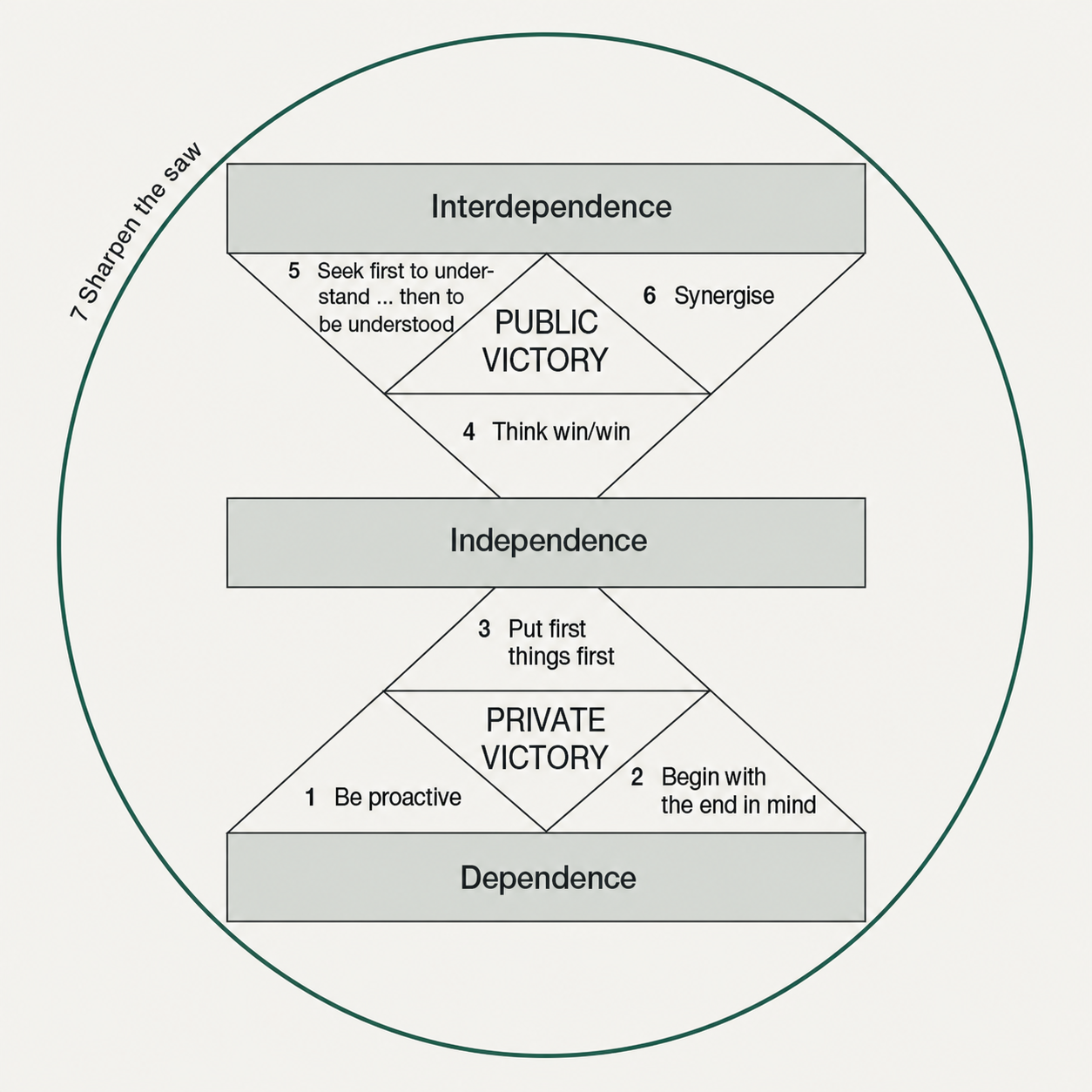
Covey’s seven habits of highly effective people

How to use it

  • Be proactive. Focus on choices and influence available in the situation. Take responsibility for conduct without pretending that people control every condition or are responsible for harm done to them.
  • Begin with the end in mind. Clarify the outcome, principles and relationships that should guide a decision. Visualise success, then test whether the desired end is ethical, feasible and shared by those affected.
  • Put first things first. Protect time for important work that is easily displaced by urgency: relationships, planning, health, prevention and capability building. Prioritisation also means declining work, changing systems and renegotiating demand—not simply becoming more disciplined.
  • Think win–win. Search for arrangements that create legitimate value for all parties. Some conflicts involve scarce resources, incompatible rights or unacceptable conduct; in those cases, fairness, boundaries or no agreement may be more honest than forced mutual benefit.
  • Seek first to understand, then to be understood. Listen to learn the other person’s meaning and perspective before advocating. Ask, reflect and verify. Understanding does not require agreement or waive the duty to challenge harm.
  • Synergise. Use relevant differences in knowledge and perspective to create a better option than any party began with. Inclusion requires psychological safety and decision rules; diversity alone does not guarantee creative resolution.
  • Sharpen the saw. Renew physical, intellectual, emotional, social and reflective capacity. Sustainable effectiveness includes rest and limits, not relentless self-optimisation.

Apply one habit to a real situation, define an observable practice and seek feedback. Review interactions and outcomes rather than judging progress from intention alone.

Final analysis

Covey’s framework endures because it connects effectiveness with character, relationships and renewal rather than offering isolated productivity tricks. Its language can support useful reflection across work and personal life.

Its limitation is the weight placed on individual agency. A manager should not use proactivity to dismiss structural barriers, “win–win” to avoid necessary conflict or self-improvement to shift organisational responsibility onto employees. The habits work best when personal practice and fair systems reinforce each other.

What happened to the journey imagined 20 years ago may involve choices, but also resources, obligations and chance. Effectiveness includes deciding which goals remain worth pursuing.

Top practical tip

Choose one live situation and practise the relevant habit as a concrete behaviour. Ask someone affected what changed; reflection becomes useful when it alters an interaction or decision.

Top pitfall

Do not turn personal responsibility into victim-blaming or assume one cultural model of effectiveness fits everyone. Account for power, disability, care, discrimination, resources and the organisation’s duty to design fair conditions.

Further reading

Covey, S.R. (1989) The Seven Habits of Highly Effective People. New York: Simon & Schuster.

Covey, S.R. (2004) The 8th Habit: From effectiveness to greatness. New York: Free Press, New York.