 keymodels
Motivational insights
How can motivational insights improve people, teams, or organisational effectiveness?
Contents
Motivations are an important factor in understanding behaviour, both in understanding ourselves and in understanding the people around us.
Motivation helps explain why the same situation energises one person and drains another. Colour-based frameworks can give teams a memorable vocabulary for discussing preferences, but they must not be treated as objective maps of personality or predictors of worth.
When to use it
Use motivational insights for voluntary reflection, team conversation and hypothesis generation about how people may respond to changing conditions. Never use a colour profile as the sole basis for hiring, promotion, redundancy, diagnosis or work allocation.
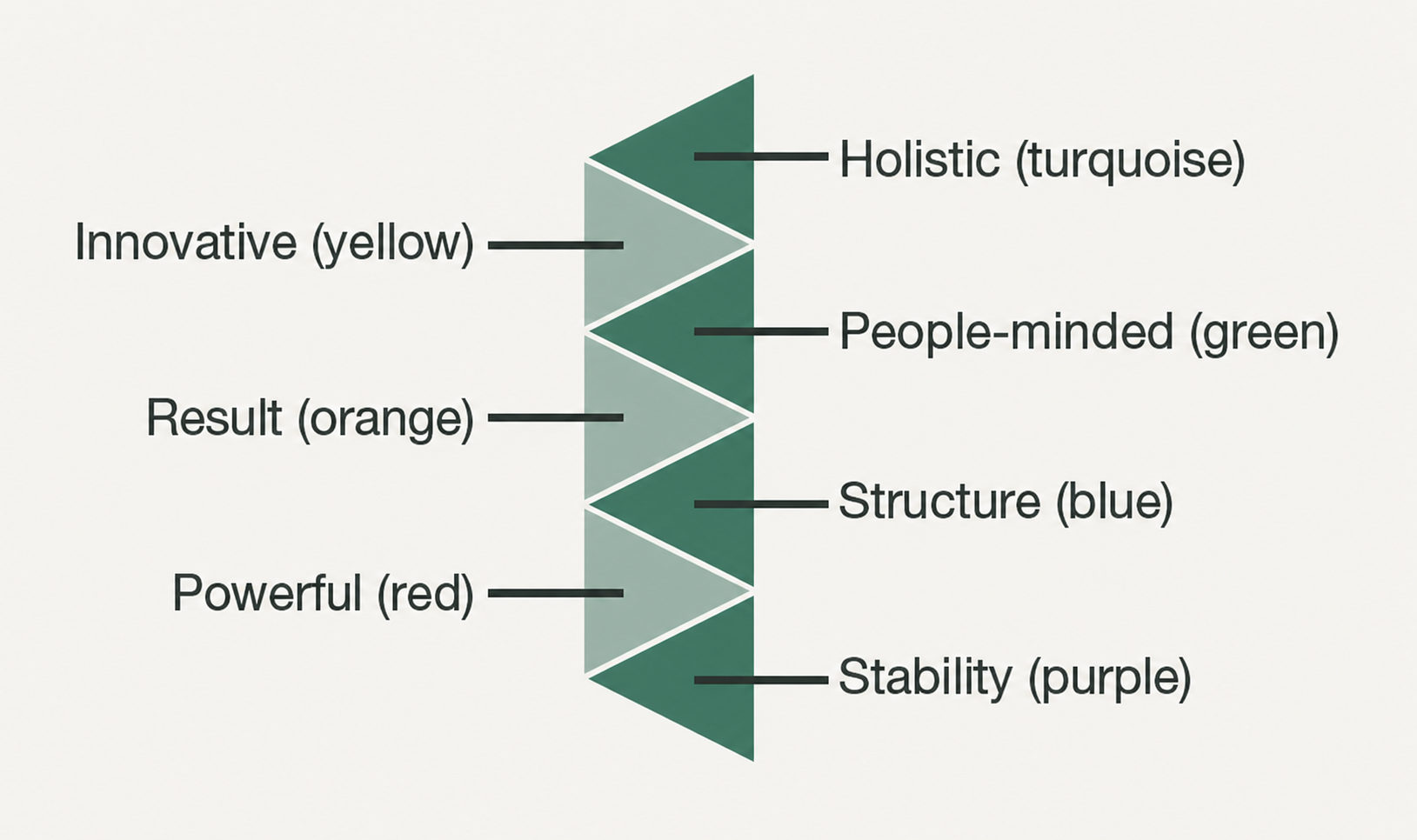
The framework proposes seven colour-coded patterns with associated motives and behaviours.
| Colour | Motivation | Characterisation | Strength | Pitfall |
|---|---|---|---|---|
| Purple | Stability |
| Able to bring people together and establish enduring bonds; has a deeper understanding of social relationships and a feel for traditions and historical values. | Difficulty adapting to rapidly changing working environments; often more loyal to the group and supervisor than they are to them; makes personal sacrifices. |
| World view | Strength | Pitfall |
|---|---|---|
| Red — Power The world demands quick, fearless action. Respond quickly and impulsively. Live in the here and now. One must earn respect. Has little trust in other leaders. Friends are for life. | Good at making choices; takes quick and resolute action; responds instinctively; protects those close to them. | Distrust and overreaction; tends to divide the world into friends and foes. |
| Blue — Structure Living by the law ensures stability and ultimately reward. Rules, agreements and discipline build character. Impulsiveness is restrained by shame. Everyone has their place. Eternal, absolute principles become a code of conduct. There is only one right way. Implementation requires a structured, carefully followed approach. | Consistent, reliable, predictable and persistent; sets a good example; loyal. | Difficulty with multitasking; may treat older agreements as more important than new objectives; sometimes blindly loyal. |
| World view | Strength | Pitfall |
|---|---|---|
| Orange — Result orientation Strategy, technology and competition lead to progress. Change is inherent in the way things are done. Progress comes from seeking the best solutions in the most effective manner. Resources are used to make life more enjoyable. Optimistic, independent risk-takers deserve success and recognition. | Driven and goal-oriented; seeks every opportunity to achieve results; continually considers their own position; does not lose sight of opponents. | Sees competition where collaboration is possible; difficulty sharing success; may break rules to achieve objectives; opportunistic. |
| Green — People-minded Feelings, sensitivity and harmony are more powerful than cold rationality. Decisions are made together through consensus. Everything revolves around harmony and personal development. Collective care and involvement are important. Everything must be fairly divided. | Creates group feeling and harmony; involves others; coordinates and prevents unnecessary competition. | May allow harmony to prevail over objectives; accepts compromises too easily; difficulty with authority and authoritative decisions; falls into endless soft discussions. |
| World view | Strength | Pitfall |
|---|---|---|
| Yellow — Innovative Flexibility, spontaneity and functionality are most important. Freedom to do and think is a highest objective. Knowledge and competence are valued over hierarchy, status and power. Differences can be integrated into mutual understanding. Existence is more important than possession. | Handles complex situations; works quickly through a model-based approach; works with uncertainty; can do many things simultaneously. | Wants to understand before acting; sometimes impractical due to theorising and placing everything in a larger framework; may appear chaotic. |
| Turquoise — Holistic The world is a cohesive organism with a collective consciousness. Everything is interconnected. Energy and information stream freely throughout. Everything revolves around holistic, intuitive thought and action. | Contributes quickly on complex assignments; does not exhibit egotism or ambition; does not commit to a single ideology. | Often incomprehensible to others; accepts perspectives so easily that others may see nihilism; does not readily show the source of personal drive. |
Origins
Clare W. Graves developed an emergent, cyclical account of value systems. Don Beck and Chris Cowan adapted and popularised it as Spiral Dynamics (1996), representing seven motivational systems with colours. The model proposes that a person can draw on several systems in a context-dependent pattern; it is not the same as a stable clinical personality typology.
Continue your preview
Read more of Motivational insights.
Create a free account to continue this advanced article preview. Complete access is available with Pro or an eligible outcome pack, so you can see the value before deciding to upgrade.