 keymodels
Maslow’s hierarchy
How can maslow’s hierarchy support strategic choice or positioning?
Contents
Differentiate market positioning.
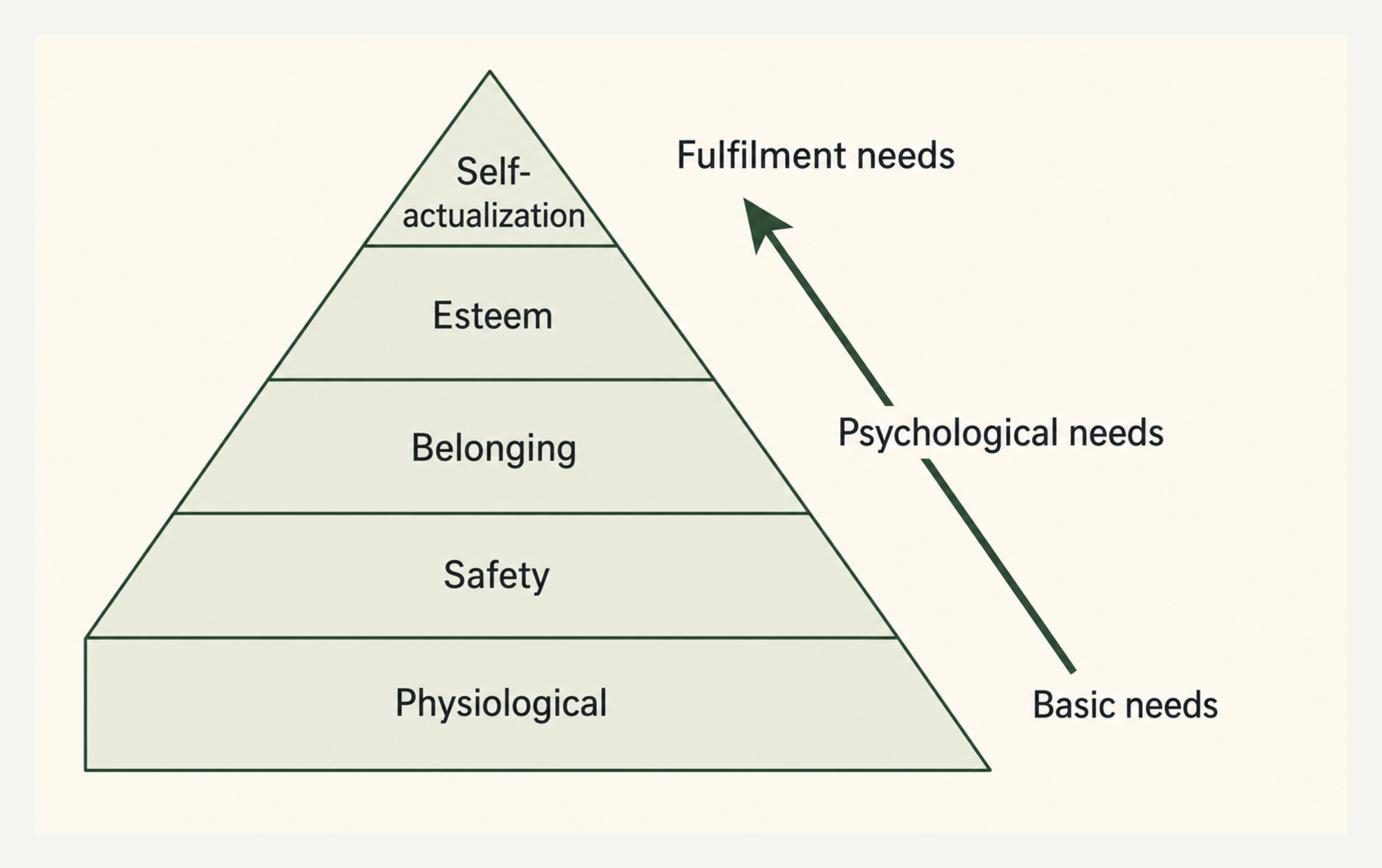
Businesses need to understand what customers and employees are trying to achieve, yet people do not always know—or accurately report—what drives a choice. Maslow’s hierarchy offers five motivational themes: physiological needs, safety, belonging, esteem and self-actualization. It is commonly drawn as a pyramid, but human needs do not reliably unfold as a universal staircase.
When to use it
- To generate hypotheses about customer or employee needs and differentiate positioning.
- To structure research while testing rather than assuming the model’s sequence.
Origins
Abraham Maslow was born in Brooklyn in 1908 to a Russian Jewish immigrant family and wrote about isolation and anti-Semitism in his early life. A biographical claim sometimes assigns him an IQ of 195, but that figure should not be treated as established evidence.
In 1943 Maslow published “A Theory of Human Motivation.” Against traditions concentrating on pathology or conditioned behaviour, his humanistic approach examined growth, meaning and potential. He proposed relative prepotency: when a more pressing need is sufficiently satisfied, another may become more salient. The familiar rigid pyramid was a later simplification, not Maslow’s own diagram.
What it is
Physiological needs concern food, water, warmth, rest and sex. Safety includes health, stability, resources and protection. Belonging concerns affection, friendship, family and participation. Esteem includes recognition, competence and self-respect. Self-actualization describes pursuing and expressing one’s potential.
The reported claim that only 2 per cent reach self-actualization, and a 1970 list of 18 illustrative people, reflect Maslow’s speculative case-based method rather than a population estimate suitable for decisions.
Developments of the model
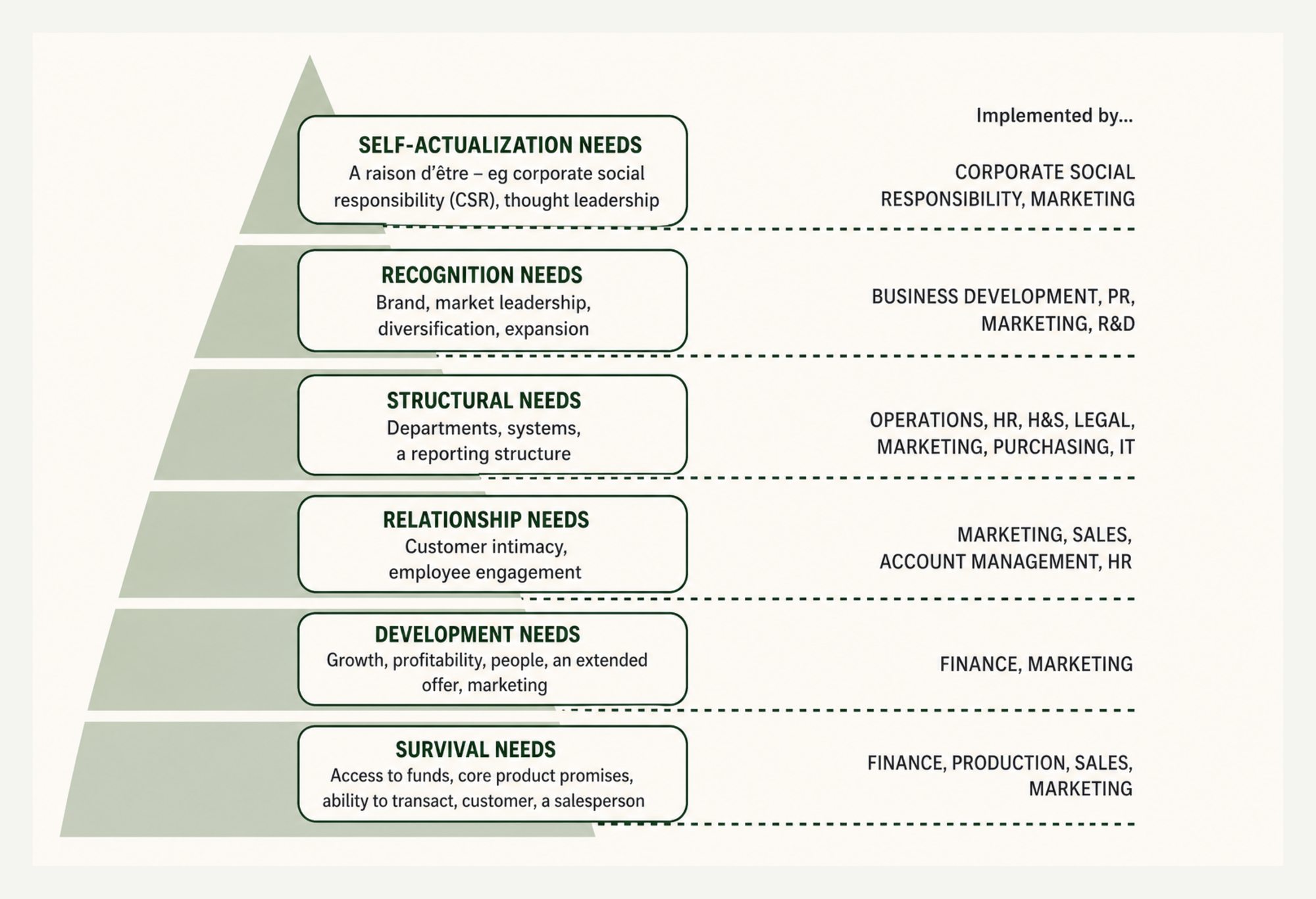
After Maslow’s death in 1970, Clayton Alderfer’s ERG account condensed needs into existence, relatedness and growth and allowed movement in more than one direction. Business adaptations also translate individual needs into organisational stages. This B2B International version is an analogy, not a law of growth.
Level 1: survival needs
A firm must deliver a viable product at an appropriate price, place and promotion. These are prerequisites, not proof of future success.
Level 2: development needs
The organisation improves its offer and economics so initial sales can become sustainable. A start-up that does not adapt may fail within its first year or two, though timing differs by context.
Level 3: relationship needs
As the business matures, marketing, key-account management, employee engagement and durable customer relationships become more important.
Level 4: structural needs
Growth often requires clearer roles, systems, controls and reporting. Technology and customer-relationship-management systems can support coordination.
Level 5: recognition needs
A larger firm manages reputation and brand deliberately. Vision and mission align choices only when reflected in behaviour.
Level 6: self-actualization needs
At this metaphorical level, purpose, social responsibility and long-term stewardship are integral to value creation. Profit remains necessary, but decisions consider commitments and stakeholder effects.
Read the layers of Maslow’s hierarchy.
Read the levels in order, then select one for its explanation.
Level 1: survival needs
A firm must deliver a viable product at an appropriate price, place and promotion.
Continue your preview
Read more of Maslow’s hierarchy.
Create a free account to continue this advanced article preview. Complete access is available with Pro or an eligible outcome pack, so you can see the value before deciding to upgrade.