
Kaizen/Gemba
How can kaizen/gemba support strategic choice or positioning?
Contents
Kaizen literally means change (kai) to become good (zen).
Kaizen means change toward the better; gemba is the actual place where value-producing work happens. Together they form a management approach in which people closest to the work improve it continuously through observation, disciplined experiments and standardisation.
When to use it
Use kaizen for recurring quality, flow, safety, inventory, cost and lead-time problems that can be improved through repeated learning. Begin at gemba with the people who perform and experience the process.
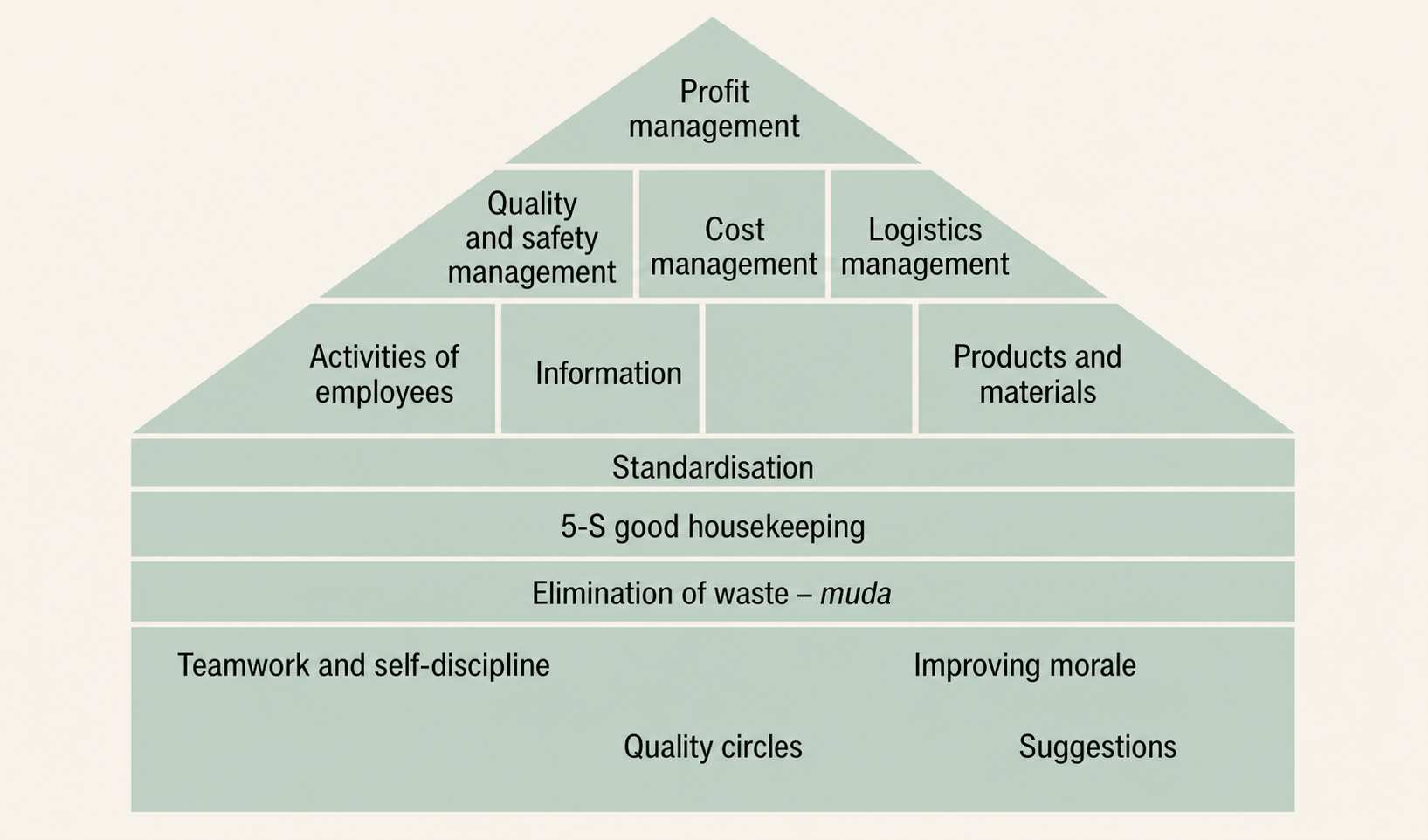
Look for waste in defects, overproduction, unnecessary transport, waiting, excess inventory, unnecessary motion and processing beyond customer need. Waste is contextual: an activity that appears non-value-adding may still be required for safety, law or resilience.
After removing obvious waste, the 5-Ss support workplace organisation:
- Seiri — separate what is necessary from what is not.
- Seiton — arrange materials, tools and information for safe, efficient use.
- Seiso — clean while inspecting for abnormal conditions.
- Seiketsu — standardise the first activities and make conditions visible.
- Shitsuke — sustain the practice through shared discipline and leadership support.
The final element is standardised work: the best currently known safe method, which becomes the baseline for the next improvement. Standardisation should preserve learning, not prevent challenge. Sustaining the 4 earlier practices, the 5-Ss and the wider 5-S method requires time, ownership and management follow-through.
A correct implementation of the kaizen concept will lead to:
- Improved productivity
- Better quality and safety
- Faster, more dependable delivery
- Lower avoidable cost
- Greater customer value
- Stronger employee problem-solving capability and morale.
Origins
Kaizen grew from Japanese post-war industrial practice and the quality and standardisation methods developed in organisations including Toyota. Masaaki Imai synthesised these practices for an international management audience and later placed gemba at the centre of the approach. He popularised a shared philosophy rather than inventing continuous improvement itself.
What it is
Its social foundations include:
- teamwork
- personal discipline
- respect for people
- quality circles
- employee-led improvement.
Kaizen combines small experiments, visual management, root-cause analysis and standardised work. Gemba keeps diagnosis grounded in the actual process rather than conference-room assumptions.
How to use it
Define the problem, customer impact and boundary. Go to the work, observe without blaming, ask the people involved and gather baseline evidence. Identify waste and likely causes.
Generate options, choose a small safe experiment, assign an owner and predict the result. Implement, measure and compare with the prediction. If the change works, update standard work, train affected people and confirm that performance holds; if not, record the learning and test a revised hypothesis.
Leaders provide time, authority, resources and psychological safety. They remove cross-functional constraints that frontline teams cannot solve. Improvement suggestions should never become unpaid extra work or a quota that rewards volume over value.
Final analysis
Kaizen is strongest for sustained incremental improvement and for building everyday problem-solving capability. It can complement but not replace redesign, capital investment or emergency intervention when the existing system is fundamentally inadequate.
Cultural stereotypes do not explain success. The enabling conditions are respect, learning, stable routines, useful measures and consistent leadership behaviour.
Top practical tip
End every event with an owner, updated standard, measure and follow-up date. An unembedded improvement is only a temporary experiment.
Top pitfall
Continuous small changes cannot replace necessary redesign, and going to gemba must not become surveillance or pressure on frontline staff to solve systemic constraints without authority.
Further reading
Imai, M. Kaizen: The Key to Japan’s Competitive Success. New York: McGraw-Hill.
Imai, M. (1997) Gemba Kaizen: A Commonsense, Low-cost Approach to Management. London: McGraw-Hill.