 keymodels
House of purchasing and supply
How can house of purchasing and supply support strategic choice or positioning?
Contents
The house of purchasing and supply is a framework developed by A.T.
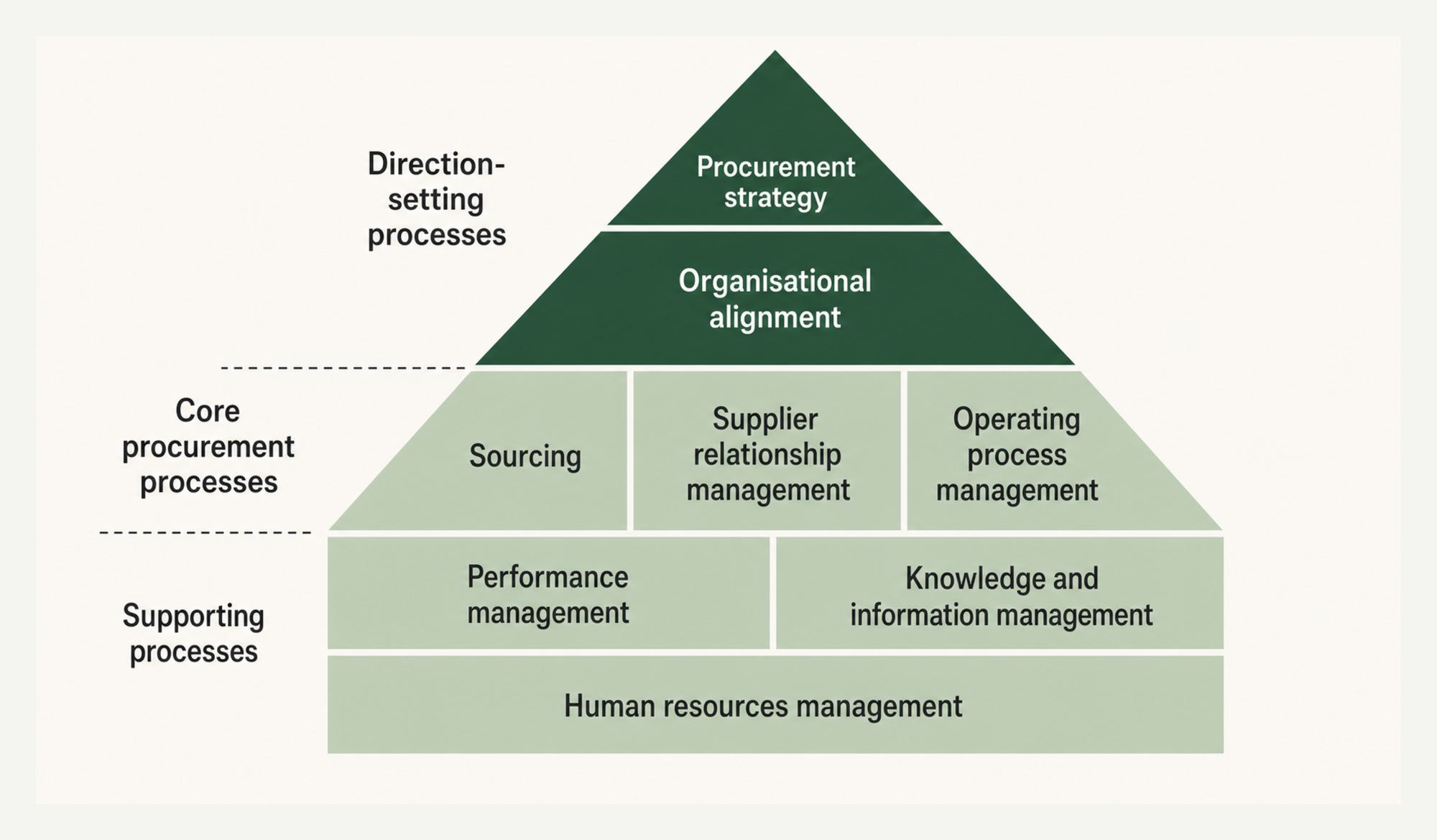
The House of Purchasing and Supply is an A.T. Kearney framework for assessing and developing the procurement function. It grew from the firm’s 1996 study of leadership practices in procurement, which involved seventy-seven high-performing organisations across industries in North America and Europe. The “house” groups more than 100 diagnostic items into eight rooms across three levels: direction setting, core procurement and supporting or enabling processes.
When to use it
Use the framework to diagnose how procurement supports business strategy, identify capability gaps, compare practices with a relevant benchmark and coordinate an improvement programme. It is most helpful when leaders need a whole-system view rather than an isolated sourcing or cost-reduction initiative.
Origins
Consulting firm A.T. Kearney developed the model from its international research into procurement leadership practices. The initial study and later Assessment of Excellence in Procurement programme translated observed differences between stronger and weaker functions into a structured benchmark. Its age means that organisations should retain the architecture while updating individual practices for current technology, regulation, resilience and responsible sourcing.
What it is
Direction-setting processes
| 1 | Procurement strategy. Connect supply-market opportunities to business strategy, using procurement to support innovation, cost leadership, risk management and revenue creation. |
|---|---|
| 2 | Organisational alignment. Place procurement knowledge and accountability in the business processes where demand and supplier decisions arise. |
Core procurement processes
| 3 | Sourcing. Apply disciplined category and sourcing methods across the expenditure base, clarifying where external supply creates value and where internal capability is strategic. |
|---|---|
| 4 | Supplier relationship management. Segment relationships and balance collaboration, innovation and value creation against dependency, continuity, conduct and performance risks. |
| 5 | Operating process management. Standardise, simplify and appropriately automate transactional work while retaining controls, accessibility and human judgement where needed. |
Supporting processes
| 6 | Performance management. Link procurement measures to enterprise outcomes and make its financial, operational, risk and sustainability contribution transparent. |
|---|---|
| 7 | Knowledge and information management. Maintain trusted data and share intelligence across processes, regions, business units and external relationships. |
| 8 | Human resource management. Build procurement capability through recruitment, development, incentives and purposeful movement of high-potential professionals across the organisation. |
Continue your preview
Read more of House of purchasing and supply.
Create a free account to continue this advanced article preview. Complete access is available with Pro or an eligible outcome pack, so you can see the value before deciding to upgrade.