
keymodels
Menu
Organisational behaviourFramework / modelModelAccessible

Competing values

How can competing values support strategic choice or positioning?

AccessibleOperationalIndividual2 min read
Contents

The competing values framework is a model for judging the effectiveness of organisations (Quinn & Rohrbaugh, 1983), but it can also be used to assess and define.

The Competing Values Framework explains why organisations can appear effective according to one standard and ineffective according to another. Robert Quinn and John Rohrbaugh derived it from the criteria experts used to judge organisational effectiveness, revealing recurring tensions between internal and external focus, flexibility and control, and means and ends. The framework also supports culture diagnosis and management development.

When to use it

Use the framework to:

  • design supervision and management-development programmes;
  • understand why functions value different ways of working;
  • diagnose gaps or overused management approaches; and
  • describe the organisation’s current and preferred culture.
Competing values
Competing values

Origins

Robert E. Quinn and John Rohrbaugh developed the framework from research into how organisational theorists and researchers judged effectiveness. Their early work identified tension among competing criteria, and their 1983 Management Science article used multivariate analysis to map three value dimensions: control versus flexibility, internal versus external focus, and means versus ends. Kim Cameron and Quinn later adapted the framework for culture assessment through the clan, adhocracy, market and hierarchy quadrants.

What it is

The model has three underlying dimensions:

  • Internal versus external focus: cohesion, people and internal systems on one side; the environment, competition and external position on the other.
  • Flexibility versus stability and control: discretion, adaptation and change contrasted with order, coordination and predictability.
  • Means versus ends: attention to processes and capabilities contrasted with final outcomes and goals.

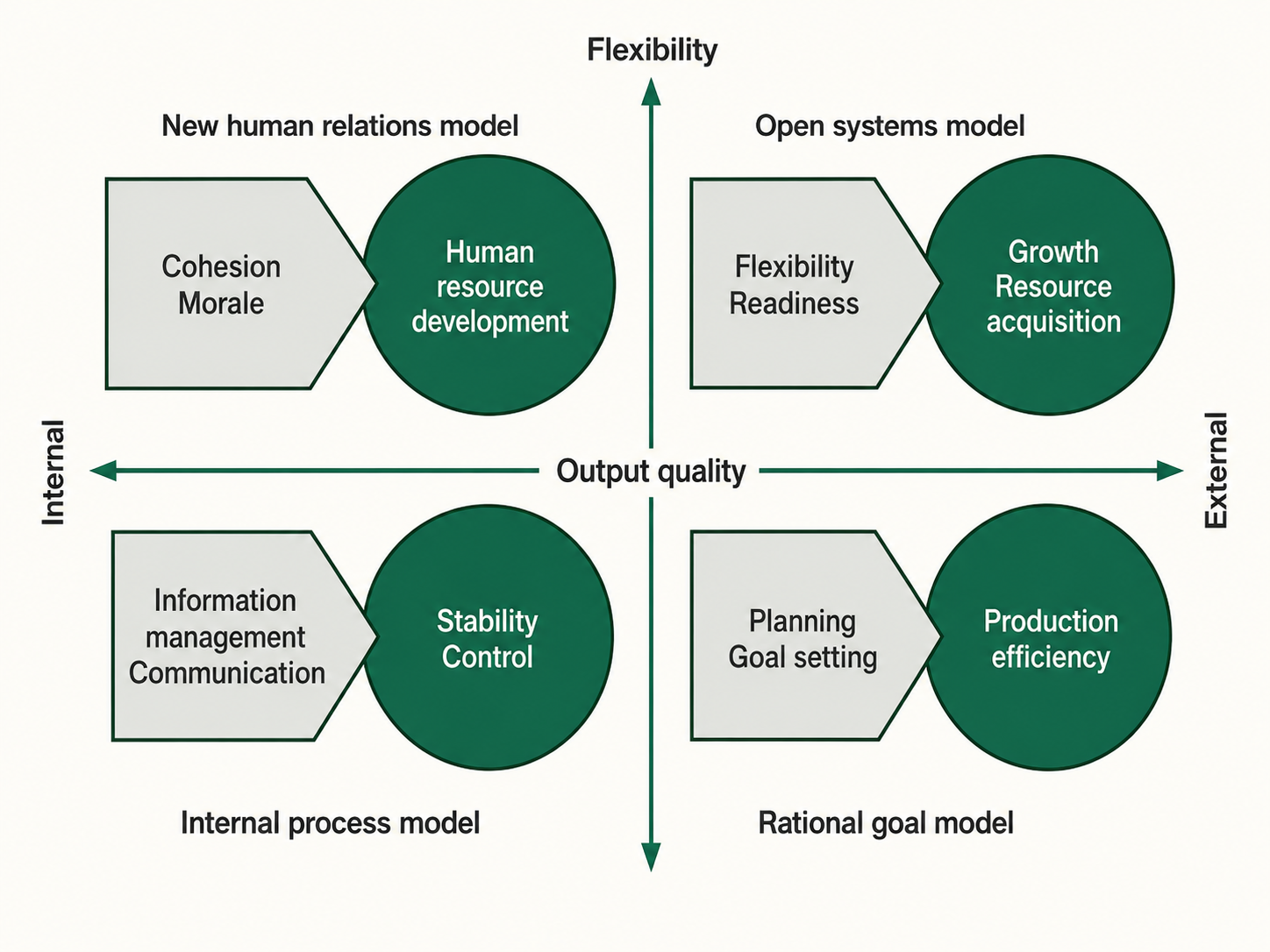
The first two axes create four effectiveness models. The third explains whether attention in each quadrant is directed towards the mechanism or the result.

How to use it

Begin with a clearly bounded unit—a team, organisation or programme—and a concrete effectiveness question. Gather views from several stakeholder groups rather than allowing the senior team to define success alone. Ask which outcomes and behaviours they value now and which the situation requires.

Map the evidence across four models:

  1. Internal process model. This quadrant values stability and internal control. Documentation, measurement, information management and reliable coordination are central. It is strongest when work is understood, consistency matters and variation creates risk.
  2. Open systems model. This quadrant values flexibility and external orientation. Adaptability, experimentation, growth, resource acquisition and environmental support matter. Leaders create conditions for initiative rather than controlling every action.
  3. Rational goal model. This quadrant combines external focus with control. Clear objectives, planning, productivity, competition and efficient execution are the route to results.
  4. Human relations model. This quadrant combines internal focus with flexibility. Cohesion, morale, participation, learning and development treat people as members of a shared social system rather than isolated resources.

Compare the current profile with the strategic requirement. An innovative unit may need more discipline to scale, while a controlled operation may need more external learning. Select a small number of practices that strengthen an underused quadrant without destroying a necessary strength.

Monitor both means and ends. Procedures can become goals in themselves, but outcome pressure can also erode the capabilities and relationships needed for future performance. The quadrants are interdependent: an effective organisation may be cohesive and productive, or controlled in routine work and flexible at the boundary.

Final analysis

The framework’s strength is that it was derived from how experts organised effectiveness criteria rather than from one ideal organisation. Its three tensions align with enduring debates about people and productivity, adaptation and control, and process and results.

The apparent contradiction is deliberate. Values that oppose one another conceptually need not be mutually exclusive in practice. High performance often requires leaders to hold both sides and shift emphasis by task and time. The simplicity becomes limiting only when users label an organisation once and stop examining the context. Quinn and Rohrbaugh also related the pattern to other organisational theories, including Parsons’s functional prerequisites, to show how values, coordination and structure can be compared through the framework.

Top practical tip

Map both the current and required profile with evidence from several stakeholder groups. Develop the neglected capability instead of declaring one quadrant universally best.

Top pitfall

Do not treat the quadrants as personality types. The values compete, but effective organisations may need apparently contradictory capabilities at the same time.

Further reading

O’Neill, R.M and Quinn, R.E. (1993) ‘Editor’s Note: Applications of the competing values framework’. Human Resource Management 32(1), 1–7.

Quinn, R.E. and Rohrbaugh, J. (1983) ‘A spatial model of effectiveness criteria: Towards a competing values approach to organisational analysis’. Management Science 29, 363–377.

Quinn, R.E. (1988) Beyond Rational Management: Mastering the Paradoxes and Competing Demands of High Performance. San Francisco: Jossey-Bass.