
Business model canvas
How can business model canvas support strategic choice or positioning?
Contents
The business model canvas as introduced by Alex Osterwalder (2010) describes the possible rationale of how an organisation creates, delivers and preserves value.
The business model canvas is a one-page framework for describing how an organisation creates, delivers and captures value. Its nine connected building blocks make the operating logic of a venture visible, giving teams a common language with which to examine an existing model, compare alternatives and design a new one.
When to use it
Use the canvas when a group needs to understand how a business works as a whole rather than discuss products, customers, operations and economics in isolation. It is particularly useful for:
- designing a new venture or proposition;
- diagnosing weaknesses or inconsistencies in a current model;
- turning strategic options into concrete operating alternatives;
- comparing competitors on a like-for-like basis; and
- recording hypotheses that can be tested before major investment.
The visual format helps participants see how changing one element—for example, the customer segment—affects channels, capabilities, partners, revenue and cost elsewhere in the system.
Origins
Alexander Osterwalder developed the framework through his doctoral research at the University of Lausanne. His two thousand and four thesis, The Business Model Ontology, synthesised earlier business-model research into a structured description of how firms operate. Osterwalder and Yves Pigneur then refined the framework collaboratively with practitioners and presented the now-familiar nine-block canvas in Business Model Generation (2010). Its design-science roots explain its emphasis on a shared visual language that can be applied, tested and revised.
What it is
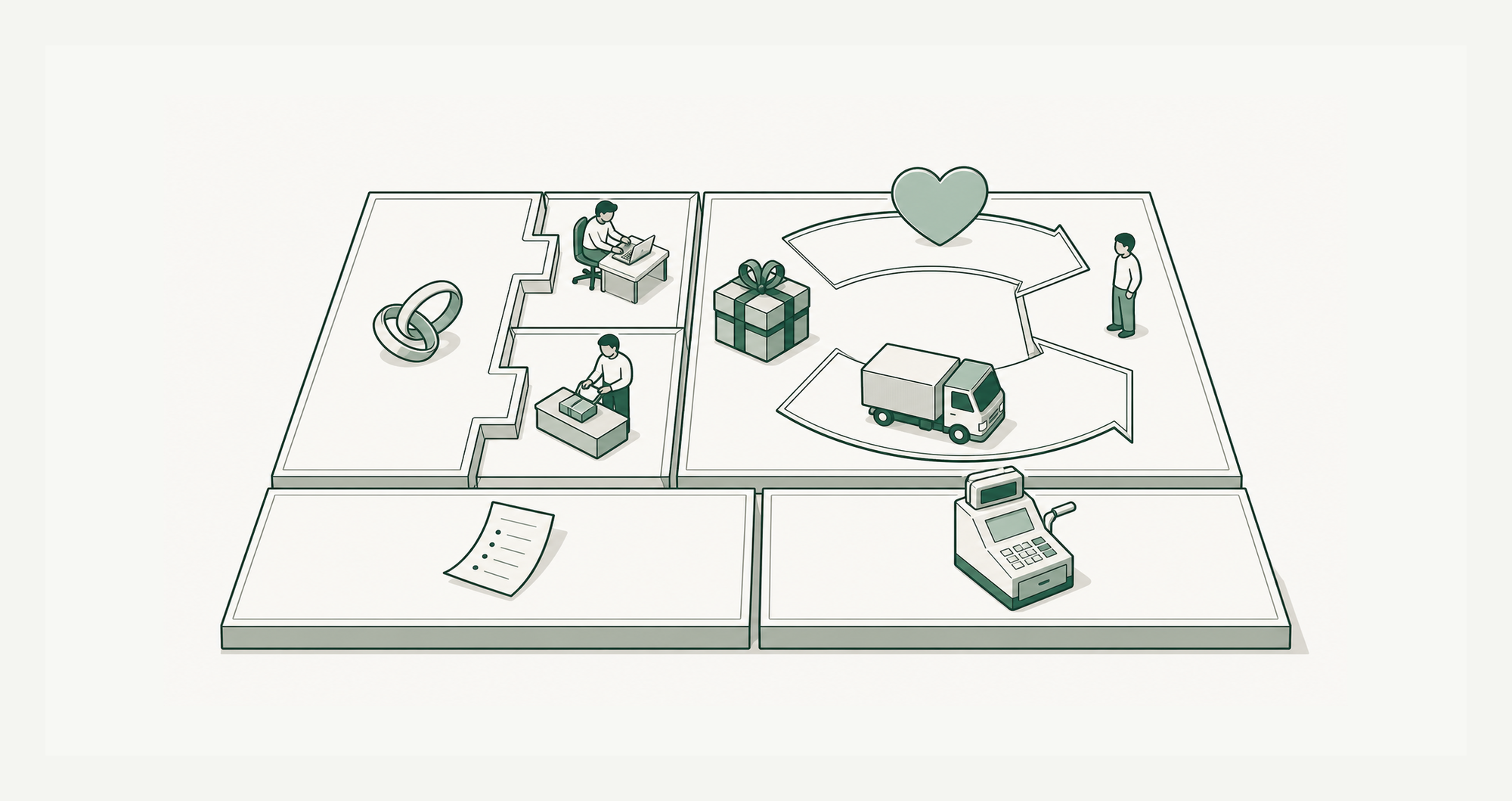
The canvas places the value proposition at the centre. Customer-facing choices sit on one side, the infrastructure needed to deliver them on the other, and the financial consequences run along the base. The model is valuable because the nine blocks are not independent boxes: together they must tell a coherent story about who receives value, how it reaches them and why the economics can work.
How to use it
Work through the nine building blocks as an interconnected system:
- Customer segments. Identify the distinct groups for whom value is created. Clarify which customers matter most, what differentiates their needs and whether each segment warrants a different model.
- Value propositions. State the combination of benefits that solves a problem or satisfies a need for each segment. Explain why customers would choose it over an alternative.
- Channels. Describe how customers discover, evaluate, buy, receive and obtain support for the proposition. Test both customer preference and channel economics, including implications for the supply chain.
- Customer relationships. Specify the form and intensity of relationship expected by each segment—from personal assistance to self-service, communities or automated interaction—and the cost of maintaining it.
- Revenue streams. Define what customers pay for, how they pay and how much each stream contributes. Distinguish transactions, subscriptions, usage fees, licensing and other possible mechanisms.
- Key resources. List the physical, intellectual, human and financial assets required to make the proposition and model work. Note resources that are scarce, proprietary or available only through privileged access.
- Key activities. Identify the work that must be performed exceptionally well to create and deliver value, operate the channels, sustain relationships and earn revenue.
- Key partners. Determine which suppliers and partners provide critical resources or perform activities more effectively, reduce risk or create scale. Make the dependency and mutual benefit explicit.
- Cost structure. Estimate the principal fixed and variable costs created by the model. Identify the most expensive resources and activities and test whether the cost base is compatible with expected revenue.

Begin with an enlarged blank canvas, physical or digital, and assemble people who understand different parts of the business. Use one short note for each important idea so assumptions can be moved or replaced. Start with customer segments and value propositions, then map channels, relationships and revenue before completing the resources, activities, partners and costs needed to deliver them.
Do not force the first draft to appear certain. Mark the claims supported by evidence, the assumptions that still require testing and the dependencies that could break the model. Create several canvases for genuinely different alternatives instead of crowding every option onto one sheet. For a new model, convert its riskiest assumptions into customer interviews, prototypes, pricing tests or operational experiments. For an existing model, compare the canvas with observed customer behaviour and financial performance.
Final analysis
The canvas is a representation, not proof that a model will succeed. Its accessibility can make unsupported claims look complete, especially when knowledge of current or prospective customers is weak. It can also encourage premature convergence: one plausible canvas is treated as the only way to execute a strategy before alternatives have been explored.
Its greatest value therefore comes from iteration. Use it to surface assumptions, expose contradictions and compare multiple configurations, then connect those choices to evidence and economics. The result should be a testable account of the business, not a polished poster.
Top practical tip
Build at least two materially different canvases, label assumptions explicitly and test the claims that combine high uncertainty with high consequence.
Top pitfall
Do not mistake a completed canvas for a validated business model. Every neat box may still contain an unsupported assumption.
Further reading
Business Model Generation website: http://www.businessmodelgeneration.com
Osterwalder, A. (2004) The Business Model Ontology. A Proposition In A Design Science Approach. University of Lausanne.
Osterwalder, A. and Pigneur, Y. (2010) Business Model Generation: A Handbook for Visionaries, Game Changers and Challengers. Hoboken, New Jersey: John Wiley & Sons.