
keymodels
Menu
OperationsFramework / modelModelAccessible

Benefits Breakdown Structure

How can benefits breakdown structure support strategic choice or positioning?

AccessibleOperationalTeam1 min read
Contents

While a Program Work Breakdown Structure is a recognized best practice in program management, a Benefits Breakdown Structure also is useful. Thiry (2004).

A Benefits Breakdown Structure (BBS) complements the familiar Program Work Breakdown Structure by showing how delivery contributes to value. Michel Thiry described the functional diagramming method in 2004 and later applied it to programmes. The structure traces the logic through which projects and non-project work create capabilities, benefits and strategic outcomes that realise the programme vision.

When to use it

  • To understand and communicate the benefits logic of a programme through a reusable structure.
  • To align teams around how components, capabilities, benefits and strategic objectives connect.
  • To turn benefits identified in the business case into owned, measurable benefit packages.

Context

This working artefact supports programme benefits management. Tailor its terminology, ownership and level of decomposition to the organisation’s governance model, stakeholders and delivery life cycle.

What it is
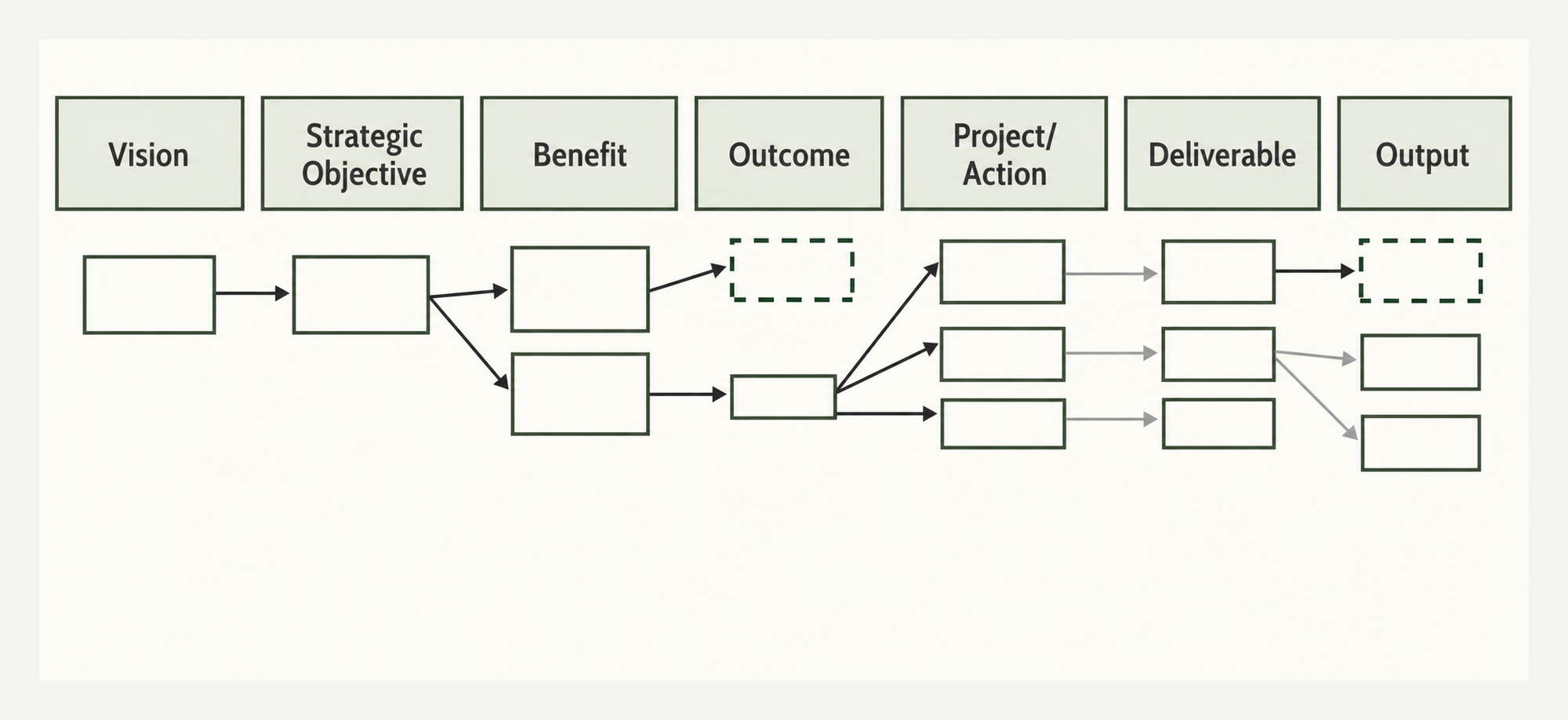
BENEFITS BREAKDOWN STRUCTURE

Purpose
Show how the programme vision is realised through a connected chain of strategic
objectives, business benefits, outcomes, project or operational actions, deliverables,
outputs and enabling capabilities.

Core logic
Vision → Strategic objective → Benefit → Outcome → Project/action → Deliverable → Output

Instructions
Build from the initial benefits statement and the benefits recorded in the business
case. Use decomposition, as with a Program Work Breakdown Structure (PWBS), to
test whether the programme has identified every expected benefit and can define its
business value and measurement approach.

1. List every project and item of non-project work in the programme.
2. Identify the specific benefits each project or operational activity should realise.
3. Add programme-level benefits that do not belong to a single component.
4. Define each identified benefit as a benefit package.
5. Link every benefit package to the relevant PWBS element.
6. Assign accountability for each benefit package to a named individual or
   organisational unit.

For each benefit package, record the intended outcome, measure, baseline, target,
timing, dependencies, owner and connection to the strategic objective and vision.
Benefits Breakdown Structure

How to use it

Start with the programme vision and strategic objectives in the business case. Decompose the programme into projects and non-project work, then identify the capabilities and outcomes each component is expected to produce. Trace those outcomes to explicit benefits, including benefits that arise only at programme level.

Treat every benefit as a managed package. Define its business value, measure, baseline, target, timeframe, dependencies and owner. Link it to the appropriate element of the PWBS so delivery and value remain connected. Review the complete hierarchy with the governance board and benefit owners to find gaps, double counting and unsupported assumptions, then use the structure throughout benefits realisation.

Top practical tip

Read the structure in both directions: every project should contribute to an intended benefit, and every promised benefit should trace back to funded work, an accountable owner and a measurable outcome.

Top pitfall

Do not confuse outputs with benefits. Completing a deliverable creates no value by itself; the resulting capability must be adopted, change an outcome and produce a measurable contribution to the programme objective.

Further reading

  • Project Management Institute (twenty eighteen). Benefits Realization Management: A Practice Guide. Project Management Institute.
  • Project Management Institute (twenty twenty-four). The Standard for Program Management. Project Management Institute.