 keymodels
7-S framework
How can 7-s framework support strategic choice or positioning?
Contents
The 7-S framework is a diagnostic model used to organise a company effectively.
The 7-S framework diagnoses organizational effectiveness through seven connected elements: strategy, structure, systems, skills, staff, style and shared values. It treats the organization as one configuration rather than a set of independent parts. A strategic choice succeeds only when the other elements can support it, and change in one element often requires adjustment elsewhere.
When to use it
Use the framework to define and analyse the most consequential features of an organization from both formal and human perspectives. It can map the present state, describe a desired future state and expose inconsistencies between them. It can also test whether the organization has the capability to execute a proposed strategy. In that role, the seven elements act like compass needles: effective execution requires them to point in a compatible direction.
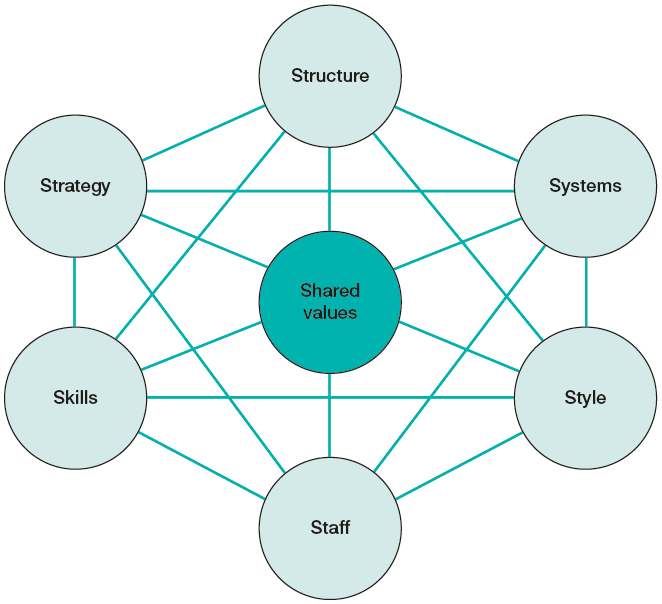
The elements are:
- Strategy – The objectives and deliberate choices used to achieve them, including priorities across products and markets and the allocation of resources.
- Structure – Hierarchy, division of labour, coordination and the mechanisms that integrate tasks and activities.
- Systems – The primary and supporting processes through which work happens, such as manufacturing, supply planning and order processing.
- Shared values – The central beliefs and expectations that explain why the organization exists and what its members consider important.
- Style – The visible evidence of management priorities: how leaders spend time, behave symbolically and relate to employees.
- Staff – The people who make up the organization and the characteristics of the workforce as a collective.
- Skills – The distinctive capabilities of the workforce and organization that persist beyond any one individual.
Strategy, structure and systems are often called the hard elements because they are comparatively formal and visible. Shared values, style, staff and skills are called soft elements because they are less tangible, not because they matter less.
Origins
McKinsey consultants Tom Peters, Robert Waterman and Julien Phillips developed the framework in the late nineteen-seventies while examining why formal structure alone could not explain organisational effectiveness. Their article “Structure Is Not Organization” argued that strategy and structure sit within a wider, interdependent system of managerial factors. Peters and Waterman subsequently brought the framework to a broad audience through In Search of Excellence. Its lasting contribution was to make coordination, people and shared values as visible as the formal organisation chart.
What it is
The model proposes that organizational effectiveness depends on alignment among all seven elements. No element can be optimized safely in isolation: a new strategy can fail when systems reward the old behaviour, a restructuring can fail when skills are missing, and stated values can fail when leadership style contradicts them.
The hard–soft distinction helps users notice what is easy to document and what is easy to overlook. Diagnosis should still examine relationships across both groups.
How to use it
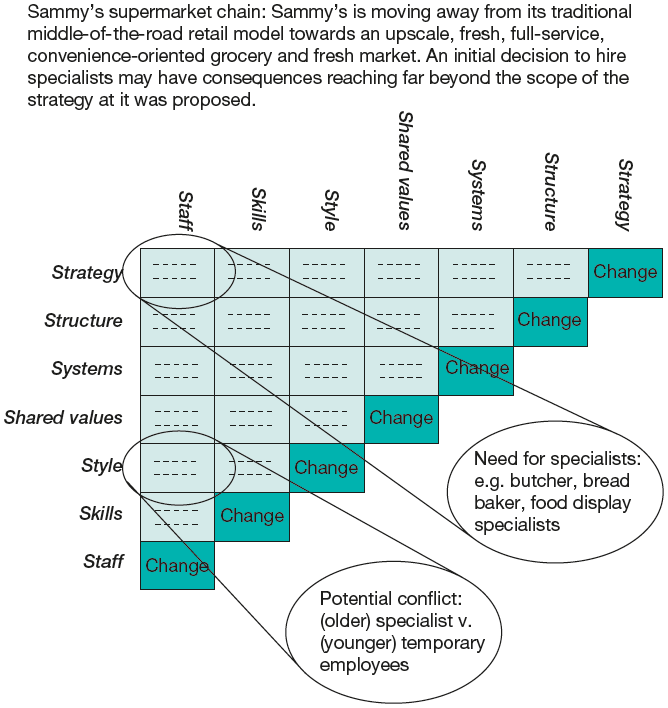
Create a matrix that describes each S in the current and intended organization. For every pair or relevant combination, record reinforcement, conflict, evidence and possible action. Then decide whether to modify the strategy, change the organization or sequence adjustments so the new configuration can operate coherently.
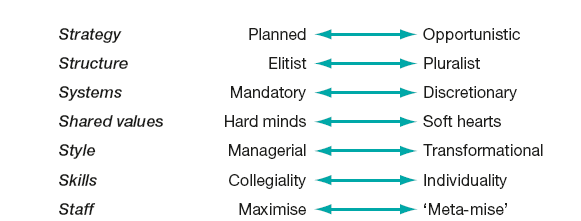
The framework's creators also intended a more sophisticated use: successful firms manage vectors of contention, or opposing poles, within the seven dimensions. Conflict is not always a defect to eliminate; capable organizations can use productive tension to adapt and perform.
Final analysis
The model is clear and robust, but the soft elements are difficult to define and measure. That difficulty often leads teams to reduce the framework to a checklist of seven issue lists.
A checklist can start a conversation but misses the central analytical task: examining relationships, contradictions and tensions. The framework identifies why current capability may be insufficient, but it does not by itself design the new capability. More focused models and interventions may be needed within individual elements once the configuration-level problem is understood.
Top practical tip
Map both the present and desired configuration, then examine the links between elements. The gaps between two lists matter less than the conflicts that would prevent the future system from working.
Top pitfall
Do not ignore the soft elements because they resist precise measurement. Shared values, style, staff and skills frequently determine whether formal changes in strategy, structure and systems take hold.
Further reading
Pascale, R.T. (1990) Managing on the Edge: How Successful Companies use Conflict to Stay Ahead. New York: Simon & Schuster.
Peters, Th.J., Waterman, R.H. (1982) In Search of Excellence. Harper Business.
Ragiel, E.M., Friga, P.N. (2001), The McKinsey Mind: Understanding and Implementing the Problem Solving Tools and Management Techniques. McGraw-Hill.