 keymodels
Value chain
How can value chain support strategic choice or positioning?
Contents
Identify product or service value during the manufacturing process.
A value chain explains how a business transforms inputs, information and effort into an offer for which customers will pay more than the total cost of producing it. It separates the firm into linked activities so managers can see where cost, differentiation and margin arise.
When to use it
- Identify how product or service value is created through the operating system.
- Locate cost, differentiation, coordination problems and opportunities for advantage.
Origins
Harvard Business School professor Michael Porter introduced the value-chain framework as part of his work on competitive advantage. It complements his industry-structure analysis: the competitive-forces framework examines pressures outside the firm, while the value chain examines the activities inside it. Porter’s Competitive Strategy appeared in 1980, and his later work developed the value chain explicitly as a way to connect activity design with cost position and differentiation.
What it is
Step 1 is to map the five primary activities:
- Inbound logistics:
- Receive, store and move the materials, components or information required by operations. Supplier relationships and input quality strongly influence performance.
- Operations:
- Transform inputs into the final product or service through production, technical work, maintenance, testing and packaging.
- Outbound logistics:
- Store, distribute and deliver the completed offer, including activities performed by external logistics partners.
- Marketing and sales:
- Generate demand, communicate the proposition, manage channels and the sales force, and establish pricing.
- Service:
- Sustain or increase value after purchase through installation, training, warranties, parts, support and repair.
Four support activities enable the primary flow:
- Firm infrastructure:
- General management, planning, finance, accounting and legal systems that coordinate and govern the enterprise.
- Human-resource management:
- Recruit, develop, reward and retain the people required across the chain.
- Technology development:
- Create and apply product and process technologies that improve cost or differentiation.
- Procurement:
- Source the goods and services used throughout the business, not only raw materials for production.
Margin is the difference between the value customers pay and the combined cost of the activities. Competitive position cannot be understood from an aggregate company total alone: each activity affects relative cost, differentiation or both.
Links between activities matter as much as the activities themselves. A sales team may acquire a promising customer, only for an inflexible credit-control process to destroy the relationship before revenue is earned. Mapping handoffs and trade-offs prevents one function’s local optimisation from reducing total value.
Developments of the model
The framework is now applied beyond a single firm to supply chains, distribution systems and wider value networks. That broader view helps a company see which participants control access, where profit pools sit and how technology or channel change redistributes bargaining power. The illustration shows a simplified chain for a chemicals manufacturer.
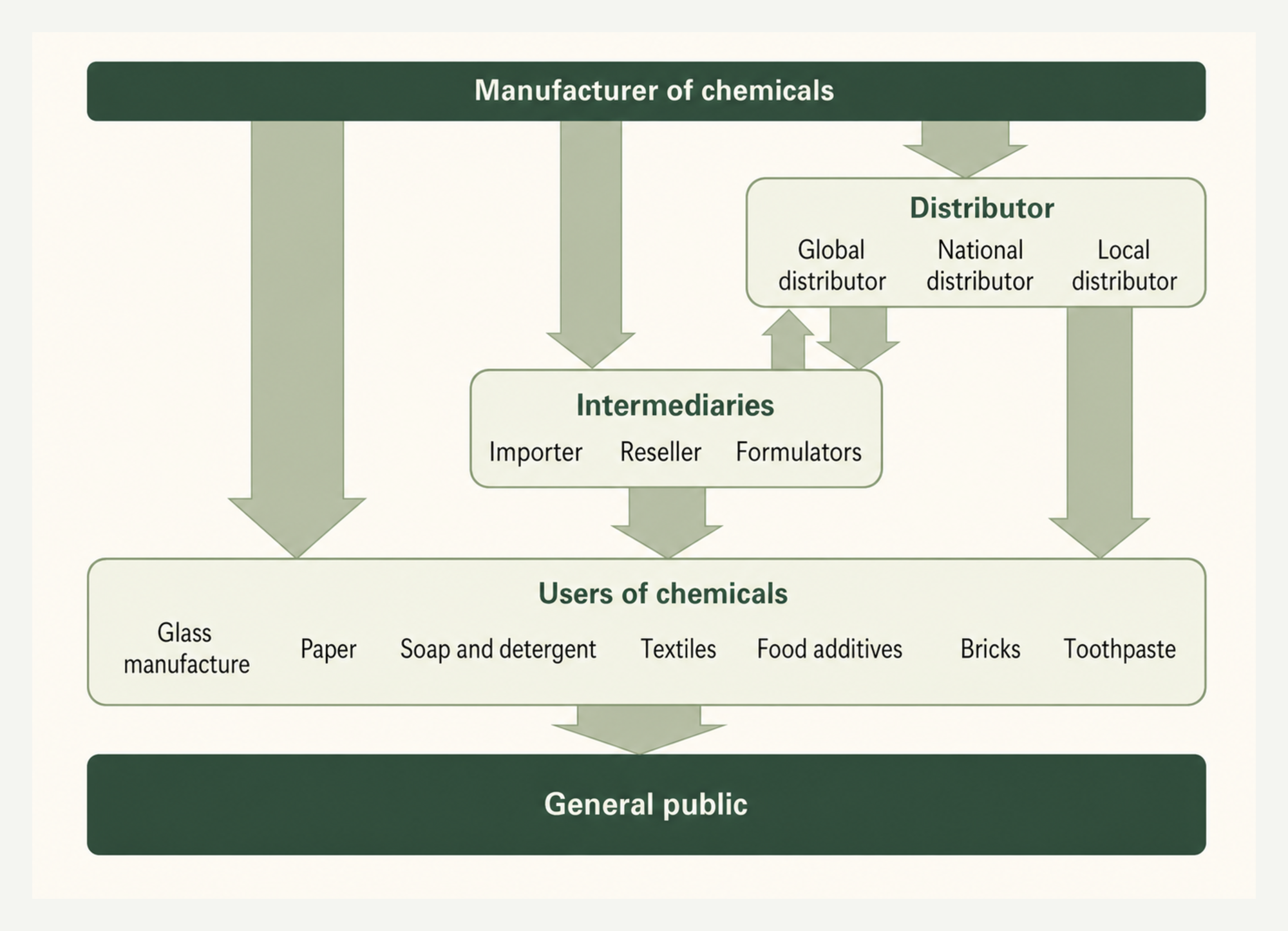
Distributor
Global National Local
distributor distributor distributor
Intermediaries
Importer Reseller Formulators
Users of chemicals
Glass
Paper Soap and detergent Textiles Food additives Bricks Toothpaste manufacture
General public
See Value chain as one connected model.
Select an element to read the article’s supporting explanation while keeping the complete set visible.
Inbound logistics
Receive, store and move the materials, components or information required by operations.
Continue your preview
Read more of Value chain.
Create a free account to continue this advanced article preview. Complete access is available with Pro or an eligible outcome pack, so you can see the value before deciding to upgrade.