 keymodels
Organisational growth model (Greiner)
How can organisational growth model (greiner) improve people, teams, or organisational effectiveness?
Contents
Greiner’s growth model helps to identify the root cause of problems that a fast-growing organisation is likely to encounter, and makes it possible to anticipate them.
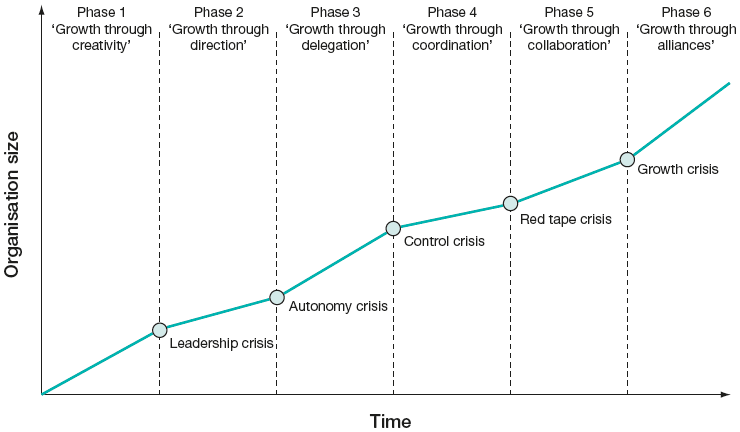
Greiner’s organisational growth model explains why management practices that enable one period of growth can create the crisis that ends it. It alternates relatively stable periods of evolution with disruptive transitions, or revolutions. The model helps leaders anticipate recurring tensions in leadership, autonomy, control, bureaucracy and growth beyond the organisation’s existing boundaries.
When to use it
Use the model when growth is exposing unclear authority, slow decisions, overloaded founders, fragmented business units or excessive process. It provides a vocabulary for diagnosing whether the current management system still fits the organisation’s scale. Treat it as a discussion framework: an organisation may skip, combine or revisit phases, and its path will depend on industry growth, ownership, technology and external shocks.
Origins
Larry E. Greiner introduced the model in his 1972 Harvard Business Review article, “Evolution and Revolution as Organizations Grow.” The original version described five phases. In the 1998 republication, he revisited the argument and added a sixth phase concerned with extra-organisational growth. The framework drew attention to time and size as design pressures and to the way each successful managerial response can plant the seeds of the next crisis.
What it is
The model uses five dimensions: (1) an organisation’s age, (2) its size, (3) its periods of evolution, (4) its periods of revolution and (5) the growth rate of its industry. Across these conditions, Greiner identifies six broad phases. Each phase is associated with a prevailing route to growth and a characteristic management crisis. The phases are patterns to investigate rather than a deterministic corporate life cycle.
How to use it
Work through the phases and compare their symptoms with evidence from your organisation. Look at decision delays, spans of control, employee discretion, cross-unit conflict, customer responsiveness and the amount of management effort consumed by coordination.
Phase 1: Creativity
The organisation concentrates on building a product and finding a market. Founders are usually technically or commercially focused, communication is frequent and informal, and employees often accept modest salaries in exchange for the prospect of ownership benefits.
Growth eventually makes informal coordination insufficient. Founders spend more time managing the organisation, conflicts over priorities increase and no one supplies consistent direction. This is the leadership crisis. Moving toward phase 2 normally requires credible management capacity and clearer accountability—not automatically replacing the founders.
Phase 2: Direction
A more directive system introduces:
- a functional organisation structure;
- accounting and capital management;
- incentives, budgets and work standards;
- more formal communication and hierarchy;
- directive top-down management.
This structure can focus effort, but it may later overload senior leaders and constrain managers closer to products and customers. The resulting autonomy crisis points toward carefully delegated authority, with explicit boundaries and information sufficient to exercise it.
Phase 3: Delegation
Decentralisation places operational and market responsibility closer to the work. Common features include profit centres, financial incentives, periodic reviews, management by exception and less frequent but more formal corporate communication supported by field visits.
Delegation can restore responsiveness, yet business units may optimise locally and senior leaders may lose visibility of collective risk. This crisis of control is not solved simply by recentralising every decision. It calls for stronger coordination, shared information and governance across units—the transition into phase 4.
Phase 4: Coordination
Organisations respond by linking dispersed units through mechanisms such as:
- grouping local units into product groups;
- more rigorous formal planning;
- corporate staff responsible for coordination;
- centralised support functions;
- corporate review of capital expenditure;
- product-group accountability for return on investment;
- lower-level profit-sharing.
These systems can allocate scarce resources more coherently. Over time, however, controls may multiply, corporate staff may become gatekeepers and procedures may be followed for their own sake. The resulting red tape crisis requires simplification, trust and faster horizontal collaboration.
Phase 5: Collaboration
The emphasis shifts from formal control to flexible cooperation through:
- problem-solving teams;
- cross-functional task groups;
- support staff assigned to specific teams;
- matrix-type structures;
- simpler control mechanisms;
- education in collaborative behaviour;
- real-time information systems;
- team incentives.
The model describes an eventual internal growth crisis: opportunities available through the organisation’s existing structure become insufficient, prompting leaders to consider relationships beyond its boundary.
Phase 6: Alliances
Growth increasingly depends on extra-organisational arrangements such as alliances, networks, mergers and holding structures. These choices create their own integration, governance and dependency risks. Before pursuing them, define the strategic capability required, the value each party contributes, decision rights, information boundaries and exit conditions.
Apply the model in a recurring review:
- Identify the phase or combination of phases that best matches observed behaviour.
- Determine whether the organisation is in stable evolution or approaching a crisis.
- Examine what the transition would mean for leaders, teams, customers and controls.
- Prepare actions that address the actual constraint while preserving useful capabilities.
- Repeat the diagnosis regularly, for example every 6–12 months, because conditions and symptoms change.
Do’s
- Ask regularly which growth tension is becoming material and what evidence supports that view.
- Recognise the organisation’s real constraints and available choices.
- Expect today’s solution to create new coordination demands tomorrow.
Don’ts
- Do not assume that every organisation passes through the crises in this order. Do not use a phase label as a substitute for analysing the organisation, its people and its industry.
Final analysis
Greiner’s model remains useful because it frames growth as an organisational-design challenge, not simply as an increase in revenue or headcount. Its central insight is that a management practice can be appropriate at one scale and restrictive at another.
Its simplicity is also its main limitation. Phase classifications can create false certainty, and the prescribed transition may not fit a regulated, professional, platform-based, public or distributed organisation. Use the framework to form hypotheses, then test them against strategy, customer needs, employee experience, performance, risk and the quality of leadership. It diagnoses a tension; it does not choose the solution.
Top practical tip
Identify the management practice that previously enabled growth but now constrains it. That transition point is more actionable than assigning the organisation a phase label.
Top pitfall
Do not treat the sequence as inevitable or the suggested response as a prescription. Organisations can skip, combine or revisit phases, and similar symptoms can have different causes.
Further reading
Greiner, L.E. (1998) ‘Evolution and revolution as organisations grow’. Harvard Business Review 76(3), 55–68.