
Lean thinking/just-in-time
How can lean thinking/just-in-time support strategic choice or positioning?
Contents
Lean thinking is also known as lean manufacturing, or the Toyota philosophy.
Lean thinking designs work around customer value, end-to-end flow, pull and continuous improvement. Just-in-time (JIT) is one operating method within that system. Waste reduction matters, but inventories are buffers whose necessity depends on variability and risk—not an evil to eliminate indiscriminately.
When to use it
Lean can improve repetitive and variable work when leadership accepts its core commitments:
- Define value through customer and stakeholder outcomes.
- Observe the real process and respect the people who perform it.
- Improve the whole value stream rather than one local metric.
- Expose problems gradually and build the capability to solve them.
Origins
Lean thinking grew from the Toyota Production System, associated with Taiichi Ohno and many colleagues, suppliers and workers. Later researchers used “lean” to describe the wider system. Its roots also include earlier flow production, quality management and Japanese post-war learning; it is not a technique created by one person in isolation.
What it is
The traditional “seven zeros” express directional ambitions:
- Zero defects
- Zero excess lot sizes
- Zero unnecessary setups
- Zero avoidable breakdowns
- Zero excess handling
- Zero avoidable lead-time
- Zero unmanaged surging
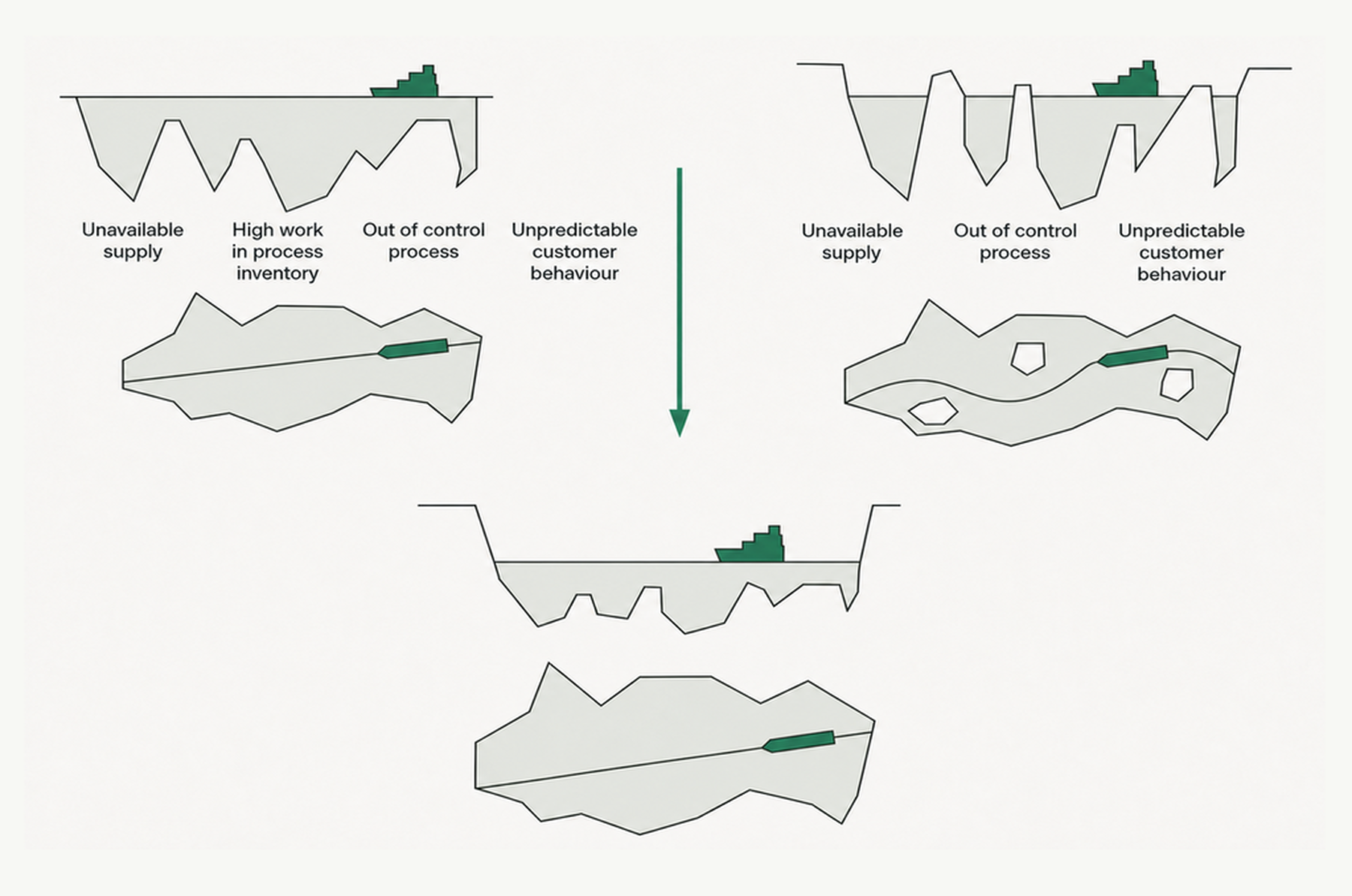
Literal zero is not always economically or physically attainable. The purpose is to expose causes and improve the system while retaining safety, resilience and required control.
How to use it
Follow five principles:
- Specify value. Identify the outcome, quality, timing and price that matter to customers, employees, regulators and the enterprise.
- Map the value stream. Visualise information and work from demand to delivery, distinguishing value, necessary non-value activity and avoidable waste.
- Create flow. Reduce queues, batches, handoffs, rework and long setup times while protecting safety and quality.
- Establish pull. Replenish from real downstream need with explicit capacity and exception rules.
- Pursue improvement. Use observation, kaizen and root-cause experiments to refine the system.
Final analysis
Implement in a risk-aware sequence:
- Define the outcome and assess whether lean/JIT addresses the actual constraint.
- Stabilise quality, equipment and standard work before cutting buffers.
- Pilot near the customer and work upstream according to system evidence.
- Check whether product and service design supports flow.
- Redesign processes and setup methods.
- Align information systems with the operating process.
- Collaborate with suppliers and customers without transferring unreasonable cost or risk.
Inventory cannot disappear entirely because work in process, lead time and variability require buffers. Dynamic environments may benefit from the theory of constraints (Goldratt, 1984), quick response manufacturing (Suri, 1998) or deliberately redundant capacity.
Don’ts
- Do not remove visible waste before understanding why it exists.
- Do not evaluate lean only through utilisation or output.
- Do not force suppliers into JIT before internal capability and fair terms exist.
- Do not imitate tools while ignoring culture, respect, authority and learning.
Top practical tip
Begin with 1 clearly defined customer outcome, map the full value stream and reduce buffers only as reliability improves.
Top pitfall
Do not transfer inventory, volatility or financial strain to suppliers and call it lean. Optimise the system and preserve proportionate resilience.
Further reading
Goldratt E.M. and J. Cox, (1984). The Goal: A Process of Ongoing Improvement. Great Barrington: North River Press.
Ohno, T. (1988) Toyota Production System: Beyond Large-Scale Production. New York: Productivity Press.
Suri, R. (1998) Quick Response Manufacturing. New York: Productivity Press.