 keymodels
Deliberate and emergent strategy (Mintzberg)
How should deliberate and emergent strategy (mintzberg) be measured and interpreted?
Contents
Mintzberg’s distinction between deliberate and emergent strategy explains how intended plans interact with learning, adaptation and the pattern of decisions an organisation actually makes.
Strategy is not only what leaders intend to do. It is also the pattern created by the choices an organisation makes over time. Henry Mintzberg’s distinction between deliberate and emergent strategy helps managers compare the planned strategy with what the organisation is actually learning and doing.
A deliberate strategy is an intended course of action that is carried through as planned. An emergent strategy is a coherent pattern that was not fully intended in advance but becomes visible through decisions, experiments and responses to changing conditions. Most realised strategies contain both: enough deliberate direction to coordinate action and enough emergence to absorb new evidence.
When to use it
Use the distinction when the market is changing faster than the planning cycle, when frontline teams are discovering opportunities that senior leaders did not foresee, or when actual investment and operating decisions no longer match the formal plan. It is also valuable during a strategy review because it separates three questions that are often confused: What did we intend? What did we actually do? What should we now choose to continue?
The more uncertain the environment, the more important it is to create room for learning. That does not automatically mean abandoning deliberate strategy. The appropriate balance depends on the cost of experimentation, the speed of feedback, the organisation’s culture and the consequences of inconsistent action.
Origins
Henry Mintzberg developed this view through empirical research into how strategies form over time. In his nineteen seventy-eight article “Patterns in Strategy Formation,” he defined strategy as a pattern in a stream of decisions and showed that realised strategies can include actions that were never part of the original plan. Mintzberg and James A. Waters formalised the deliberate–emergent continuum in nineteen eighty-five, distinguishing purely deliberate and purely emergent strategies as conceptual endpoints with several practical forms between them. Mintzberg later used this work to challenge the idea that formal planning and strategy formation are the same activity.
What it is
The framework distinguishes four related elements:
- Intended strategy: the goals and choices leaders initially set.
- Deliberate strategy: the part of that intention that the organisation implements as planned.
- Unrealised strategy: intentions that are dropped, blocked or overtaken by events.
- Emergent strategy: a consistent pattern that develops without having been fully planned.
Deliberate and emergent strategies together form the realised strategy—the pattern visible in the organisation’s actual commitments and behaviour.
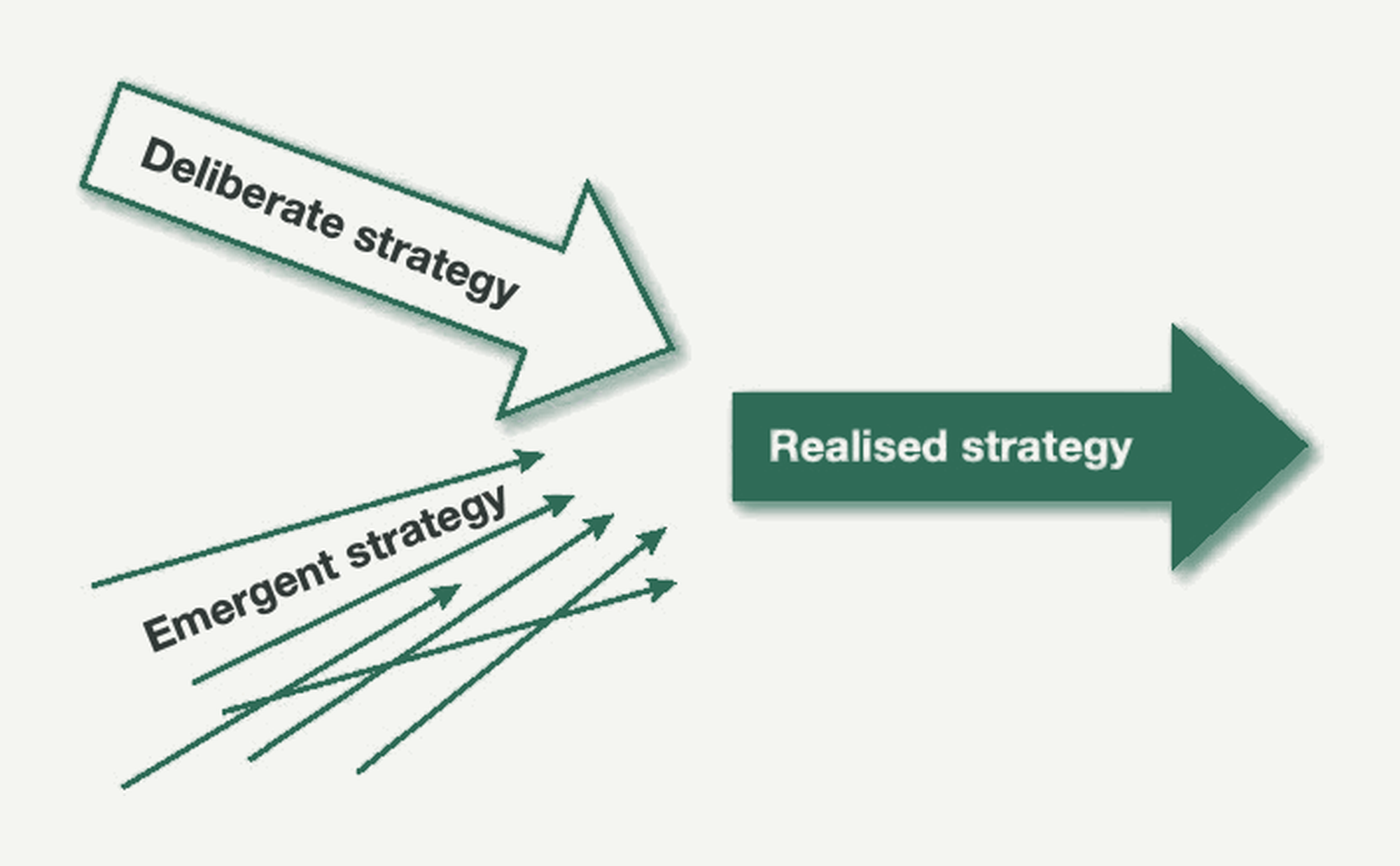
Emergence is not the same as improvising without direction. A local experiment becomes strategically relevant only when it produces a meaningful pattern, supports an advantage or capability, and earns an explicit decision to continue. Similarly, a formal plan is not a realised strategy until resources and behaviour consistently support it.
Continue your preview
Read more of Deliberate and emergent strategy (Mintzberg).
Create a free account to continue this advanced article preview. Complete access is available with Pro or an eligible outcome pack, so you can see the value before deciding to upgrade.