 keymodels
Core competencies
How can core competencies support strategic choice or positioning?
Contents
A core competence is something unique that a firm has, or can do, strategically well.
A core competence is a collective capability that an organisation performs distinctively well and can deploy across products or markets. Examining these capabilities reveals what the company can credibly become, not only what it sells today. Prahalad and Hamel brought the concept to wide attention in 1990, developed it further in 1990 discussions and expanded it again in 1994. It complements Barney’s resource-based view, which links sustainable advantage to valuable tangible and intangible resources that rivals cannot readily imitate or replace.
When to use it
Use the model to identify the capabilities that create customer value and distinguish the organisation from rivals. It supplies an inside-out counterpart to Porter’s Five Forces (Competitive analysis: Porter’s five forces model), which begins with the external industry. Core-competence analysis asks whether the company can combine learning and technology to create unexpected products more quickly or economically than competitors and thereby support enduring advantage.
Origins
C.K. Prahalad and Gary Hamel introduced the concept to a broad management audience in their 1990 Harvard Business Review article “The Core Competence of the Corporation.” Their 1994 book Competing for the Future placed competence leadership within a wider agenda of strategic intent and future-market creation. Jay Barney’s 1991 synthesis of the resource-based view developed a related explanation of advantage through valuable, rare and difficult-to-imitate resources.
What it is
A core competence integrates skills, knowledge and technologies across organisational boundaries. It must open access to several markets, contribute materially to the benefit customers perceive and resist imitation. Operational proficiency in one activity is therefore insufficient: the capability must transfer across offerings and provide a basis for advantage.
How to use it
Begin by testing candidate capabilities against all three conditions:
- It creates a benefit that customers value.
- Competitors cannot reproduce it easily.
- It can be applied across multiple products and markets.
A company can create durable advantage by developing, acquiring and combining distinctive assets into valuable offers. The analysis must explain both the origin of that distinctiveness and the mechanism that will preserve it. Ask:
- Which customer value will we need to deliver in 10 years?
- Which combinations of skill and technology must we build or obtain to deliver it?
- How will those capabilities change the way we work with customers?
The exercise should mobilise underlying strengths while extending management’s time horizon. Future products and industries may not yet be technically or commercially feasible, so the team must consider several plausible competitive arenas. Prahalad and Hamel argue that competence thinking reveals whether the organisation can claim part of that uncertain future. To develop this foresight:
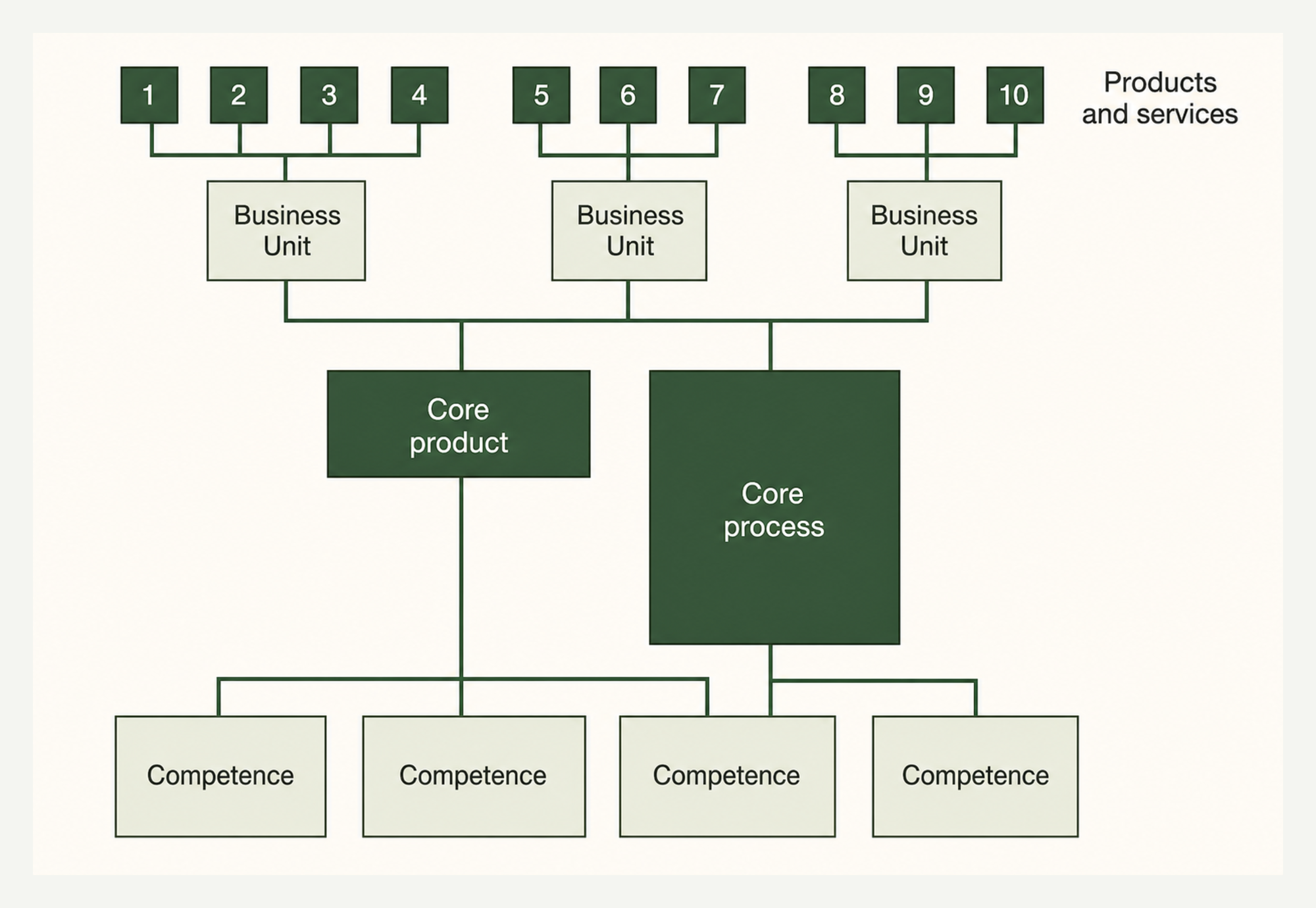
- View the company as a portfolio of competences as well as a collection of business units.
- Use evidence from processes, products and services to determine which competences exist or should exist. Volvo, for example, can be framed not only as a car manufacturer but as an organisation with capabilities in product design, human safety, protection and vehicle testing.
Continue your preview
Read more of Core competencies.
Create a free account to continue this advanced article preview. Complete access is available with Pro or an eligible outcome pack, so you can see the value before deciding to upgrade.