
Change quadrants
How can change quadrants support strategic choice or positioning?
Contents
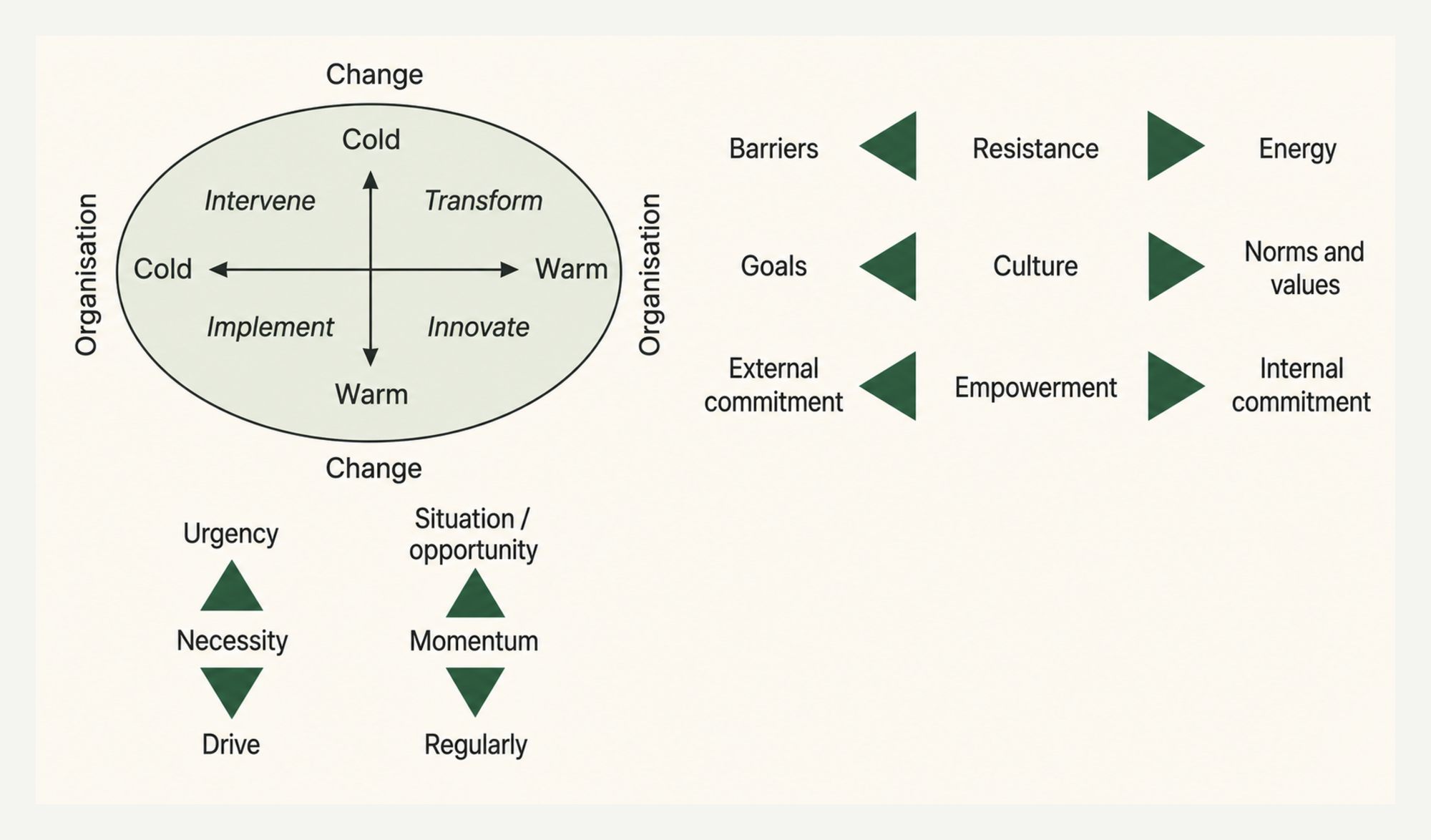
The basic premise of the model is that the most appropriate change strategy depends on whether an organisation is warm or cold, and whether the motivation for change is.
The change-quadrants model argues that a change strategy should fit both the organisation and the reason for changing. Each can be relatively warm or cold. A cold organisation coordinates work mainly through rules, systems, structures and procedures; a warm organisation relies more heavily on shared values, norms, professional commitment and common direction.
When to use it
Use the framework to select a broad change approach, identify credible change agents, decide who must participate and shape the pace, scope and communication of the work. It is particularly useful when a standard change method feels mismatched to the organisation’s culture or motivation.
Diagnosis is qualitative. Interview leaders, professionals and front-line participants; examine how decisions are actually coordinated; and distinguish formal descriptions from observed behaviour. The aim is not a permanent label but a sufficiently accurate view of the conditions surrounding this change.
Origins
The framework is attributed to Dutch organisational-change writers Steven ten Have, Wouter ten Have, Friso Stevens and Marcel van der Elst, whose work appeared in the early 2000s. They combined the warm–cold distinction for both organisation and motive to select among intervention, implementation, transformation and innovation. The model belongs to the contingency tradition: no single change process is appropriate regardless of context.
What it is
A cold motive is an externally evident necessity: imminent financial distress, a severe fall in market share or profit, regulation or an unavoidable competitive threat. A warm motive grows from aspiration, professional ambition or a shared desire to create a better future before crisis makes action compulsory.
Combining organisational character with motivation produces four strategies: intervention, implementation, transformation and innovation or renewal. The labels indicate the dominant mode, not an excuse to ignore complexity within the organisation.
How to use it
Assess the two dimensions separately. For the organisation, ask whether people coordinate primarily through formal authority and process or through professional norms and shared meaning. For the motive, test whether credible necessity or collective aspiration is doing most of the work. Use the resulting quadrant to choose an initial strategy and communication pattern.
- Intervention communication. When change is imposed in a cold setting, line management communicates directly from the top. State the decision, evidence, boundaries and consequences clearly. Combine consistent group messages with attentive one-to-one discussion. The manager becomes the visible face of the change, so tone and behaviour must match the message.
- Implementation communication. When a formally organised company pursues an ambition, explain the benefits, results and plan in a motivating way. Project teams can supply evidence, but management should normally demonstrate the desired behaviour. Communication resembles disciplined internal campaigning: maintain focus without substituting promotion for participation.
- Transformation communication. When necessity confronts a warm professional organisation, leaders set the non-negotiable outcome and constraints while involving professionals in designing how to achieve it. Close both formal and informal information loops. The task is to balance central coordination with facilitation and local judgement.
- Innovation or renewal communication. When ambition arises inside a warm organisation, enable decentralised, bottom-up exchange around a shared purpose. Leaders monitor the communication process, make progress visible and provide broad facilitation. Two-way interaction matters: participants report learning while actively seeking ideas and criticism.
For every quadrant, specify the purpose, audience, messenger, feedback route and evidence of understanding. Communication should evolve as the motivation, confidence and stakeholder landscape change.


Final analysis
The model deliberately simplifies. Leadership preferences and capability also affect which intervention can be executed. A cold necessity is usually easier to state and schedule than a warm aspiration, and organisations frequently describe themselves as more values-led than their actual decisions suggest. Management style and behaviour must support the chosen mode.
Different functions, locations and phases may occupy different quadrants. Use this model to select the dominant strategy and communication pattern, then combine it with a process model such as Kotter’s eight phases to plan the work. Revisit the diagnosis rather than allowing communication to run on autopilot.
Top practical tip
Interview people at several levels and compare formal systems with real behaviour before selecting a quadrant. The quality of the strategy cannot exceed the quality of the diagnosis.
Top pitfall
Do not force a complex change into one quadrant. Different workstreams and stakeholder groups may require different approaches, and the diagnosis should be revisited as uncertainty and resistance change.
Further reading
Kotter, J.P. (1990) A Force for Change: How Leadership Differs from Management. New York: Free Press.
Ten Have, S., Ten Have, W.D., Stevens, F. and Van der Elst, M. (two thousand and three) Key Management Models. Harlow: Pearson Education.
Ten Have, S. and Ten Have, W.D. (two thousand and four) Het boek verandering: Over het doordacht werken aan de organisatie. Amsterdam: Nieuwezijds.