 keymodels
Reverse innovation (Govindarajan)
How can reverse innovation (govindarajan) support strategic choice or positioning?
Contents
The winners of tomorrow, says Govindarajan, will be those who take the diametrically opposite approach: innovate in the developing world and export to.
Reverse innovation begins with the needs and constraints of an emerging market, develops an offer locally and later adapts that innovation for adoption in a wealthier market. Vijay Govindarajan’s central challenge to multinationals is to create where the unmet need exists rather than merely export a diluted version of a product designed elsewhere.
When to use it
- Use the framework when an offer designed for a high-income market is unaffordable, inaccessible or poorly suited to customers in an emerging market.
- Explore whether local constraints could produce a simpler, more resilient or more economical solution with value in other markets.
- Use it when a locally successful competitor may enter the company’s home market from a different cost and capability base.
- Avoid assuming that countries or customers form homogeneous “developed” and “developing” groups; define the actual job, infrastructure and segment.
Origins
Vijay Govindarajan and collaborators developed and popularised the reverse-innovation concept through research with multinational companies. Govindarajan defines it as innovation adopted first in a lower-income or emerging market that later “flows uphill” into a wealthier one. His book Reverse Innovation: Create Far from Home, Win Everywhere, co-authored with Chris Trimble and published in 2012, organised the managerial approach and cases.
What it is
Reverse innovation is not the export of an existing premium product after removing features. It gives a local team authority to redesign the value proposition, cost structure, technology, distribution and business model around local conditions.
Reverse innovation
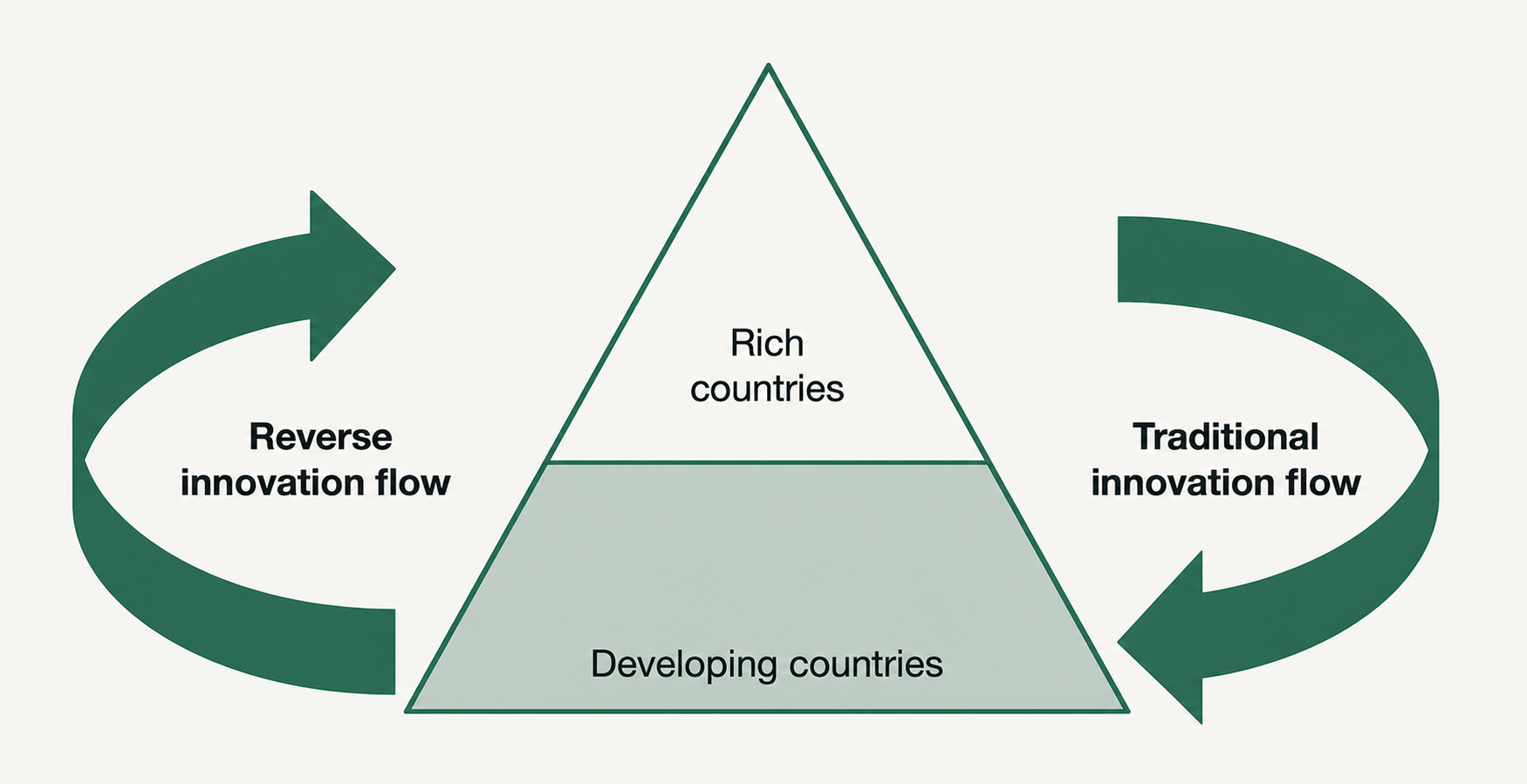
The process becomes “reverse” when the resulting innovation is subsequently adopted in a market traditionally treated as the source of innovation. The transfer may require new features, certification, channels or positioning, but the core architecture originates in the first market.
One strategic example concerns tractors. Mahindra built robust, fuel-efficient machines suited to many Indian smallholders, including models around 35HP, and entered the United States in the mid-1990s. Rather than challenge giant agricultural machines of up to 600HP directly, it served hobby farmers, landscapers and contractors. Product adaptation and dealer service supported growth.
John Deere later strengthened local design for India instead of relying on stripped-down products conceived for the US. The case illustrates both directions: an emerging-market company can move upward, while a multinational can establish local innovation capability and then transfer learning across markets.
Continue your preview
Read more of Reverse innovation (Govindarajan).
Create a free account to continue this advanced article preview. Complete access is available with Pro or an eligible outcome pack, so you can see the value before deciding to upgrade.