 keymodels
Innovation circle
When and how should innovation circle be applied?
Contents
The innovation circle is a model for efficiently analysing and successively managing the life cycle of a new innovation.
The innovation circle manages an innovation from the stimuli that generate ideas through development, launch, operational delivery and eventual renewal. Its central insight is that exploration, implementation and commercial operation require different management disciplines.
When to use it
Use the circle to create an end-to-end view of a product, service or process innovation, clarify handoffs and prevent teams from treating launch as the end of innovation management. It is particularly helpful when creative work and operational integration are disconnected.
Origins
The innovation circle is a practical synthesis rather than a model with one documented inventor. It draws on new-product development, diffusion and operations management. Its closest established relative is Robert G. Cooper’s Stage-Gate approach, developed from research into new-product success in the late twentieth century. The circle places more emphasis on capitalisation, service and the way one lifecycle stimulates another.
What it is
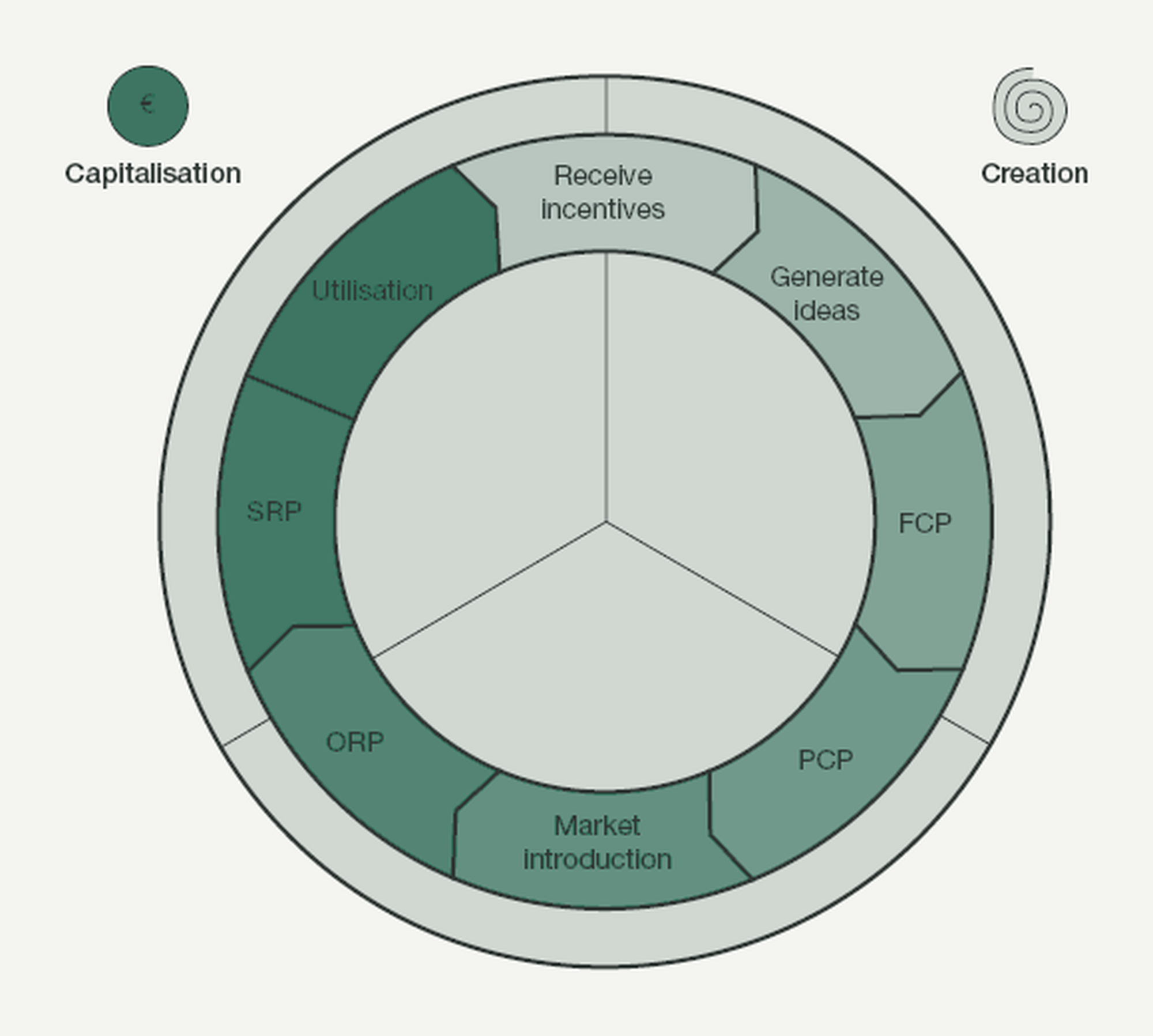
The model has three phases: creation, implementation and capitalisation.
| 1 | The creation phase. Discover and organise the seeds of products, processes and services. | |
|---|---|---|
| (i) | Receive incentives – interpret signals such as slowing growth, weaker brand performance, declining satisfaction, unmet needs or new technology. | |
| (ii) | Generate ideas – create several responses in an exploratory climate, then assess customer value, return, risk and resources before selecting ideas to develop. | |
| (iii) | Function creation process (FCP) – translate the selected idea into customer and system functions, assumptions and controllable risks. | |
| 2 | The implementation phase. Develop the concept and prepare its introduction. | |
| (i) | Product creation process (PCP) – turn functions into specifications, prototypes and tested product or service designs. | |
| (ii) | Market introduction – prepare and execute launch while readying operations for repeatable fulfilment. | |
| 3 | The capitalisation phase. Integrate delivery and manage the innovation’s economic contribution. | |
| (i) | Order realisation process (ORP) – establish reliable production, logistics and order fulfilment, integrated with existing operations where that creates value. | |
| (ii) | Service realisation process (SRP) – embed any new service in support and service-delivery systems. | |
| (iii) | Utilisation – manage revenue, margin, cost and incremental improvements until retirement, then feed learning and unmet needs into the next cycle. |
Continue your preview
Read more of Innovation circle.
Create a free account to continue this advanced article preview. Complete access is available with Pro or an eligible outcome pack, so you can see the value before deciding to upgrade.