 keymodels
Client pyramid (Curry)
How can client pyramid (curry) support strategic choice or positioning?
Contents
If you can successfully identify your most valuable customers, acquire them, keep them and increase their purchases, you will generate significantly more value than.
Customers differ in the revenue, profit, potential and strategic value they contribute. Jay and Adam Curry’s client pyramid segments the customer base into value tiers, placing a small group of high-value relationships at the top and larger groups of lower-value or prospective customers below. The purpose is to focus acquisition, retention and development effort where it can create the greatest return.
When to use it
Use the pyramid when a uniform sales or service model allocates similar effort to customers with very different economics. The analysis can:
- show how revenue and profit are distributed across the base;
- define differentiated account-management, marketing and service policies;
- protect and deepen the most valuable relationships;
- identify cross-selling and up-selling opportunities that can move suitable customers upward; and
- prevent high-cost attention from being assigned where the relationship cannot support it.
The model should guide fair differentiation in proposition and resource intensity, not poor treatment of customers placed in lower tiers.
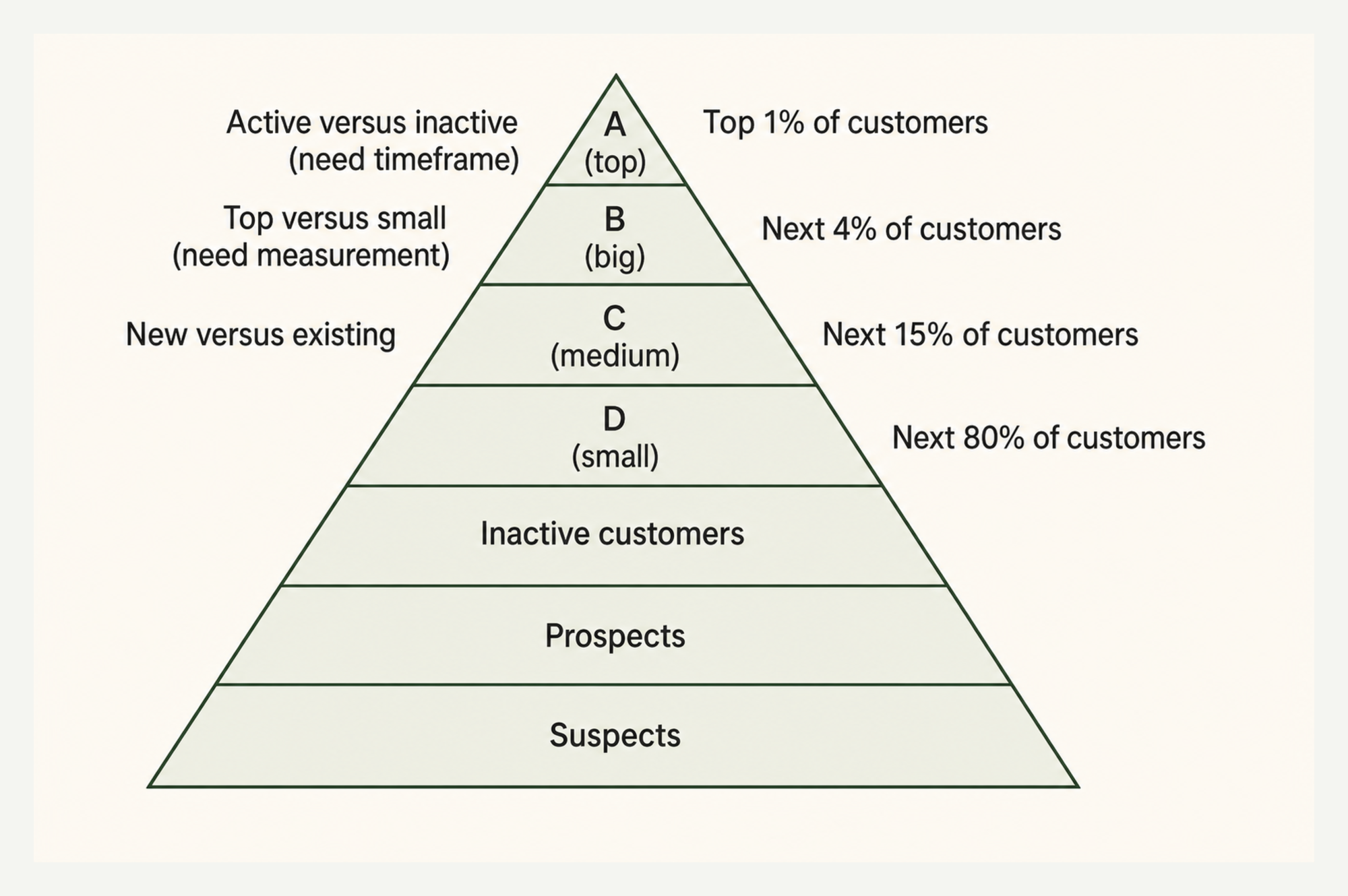
Origins
Jay Curry introduced the customer-pyramid approach in Know Your Customers (nineteen ninety-two), drawing on direct marketing, database segmentation and the Pareto observation that a minority of customers often produces a disproportionate share of sales or profit. Jay and Adam Curry developed it further in The Customer Marketing Method (two thousand), connecting value tiers with differentiated acquisition, retention, cross-selling and service. The method is related to later customer-profitability segmentation, but tier rules must reflect the economics of the particular business.
What it is
The pyramid places current and potential customers into ordered tiers using economic and strategic value. A small top tier receives the most tailored relationship investment; larger lower tiers receive propositions and service appropriate to their needs, value and potential. Movement matters as much as placement: the organisation should acquire the right prospects, retain valuable customers and develop relationships whose future contribution can justify the investment.
Continue your preview
Read more of Client pyramid (Curry).
Create a free account to continue this advanced article preview. Complete access is available with Pro or an eligible outcome pack, so you can see the value before deciding to upgrade.