 keymodels
Business process redesign
When and how should business process redesign be applied?
Contents
Hammer and Champy (1993) define business process redesign (BPR) as the fundamental reconsideration and radical redesign of organisational processes, in order to achieve.
Business process redesign (BPR) is the fundamental rethinking and radical reconstruction of an organisation’s end-to-end processes to achieve dramatic gains in cost, quality, service or speed. It begins with the value required by customers and frequently uses information technology to make a genuinely different way of working possible.
When to use it
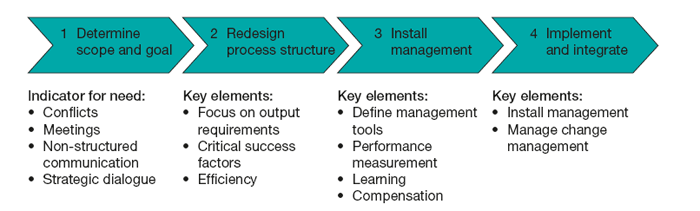
Use BPR when incremental improvement cannot close a material performance gap and the existing process is fragmented across functions, systems or layers of approval. Warning signs include:
- recurring conflict over responsibility or hand-offs;
- frequent coordination meetings needed to keep routine work moving;
- excessive unstructured communication through messages, memos and announcements;
- long delays, duplicate entry, repeated checks or extensive rework; and
- benchmarking evidence of a major disadvantage in cost, quality, service or speed.
Because BPR is disruptive, reserve it for consequential processes where radical change is justified rather than using it as the default response to every inefficiency.
Origins
Business process redesign emerged as a management movement around nineteen ninety through parallel work by Michael Hammer and by Thomas Davenport and James Short. Hammer’s Harvard Business Review article “Reengineering Work: Don’t Automate, Obliterate” argued that organisations should challenge obsolete processes instead of using technology merely to accelerate them. Davenport and Short similarly framed information technology as an opportunity to redesign work across functional boundaries. Hammer and James Champy’s 1993 book Reengineering the Corporation brought the approach to a wider management audience and popularised its emphasis on fundamental, cross-functional change.
What it is
BPR treats a process as the complete sequence that transforms inputs into an outcome valued by a customer. It therefore follows work across departmental boundaries rather than optimising each department separately. The central question is not “How can this task be performed faster?” but “If this outcome had to be delivered today, how should the entire process be designed?”
How to use it
Apply four governing rules:
Set strategy first. Define the customers, outcomes and performance priorities that the redesigned process must serve. Redesign primary processes before support processes. Start with the transformations that directly create the required product or service; optimise enabling activities only after that flow is clear. Use information technology as an enabler. Explore what becomes possible when information is available at the point of need, work can occur in parallel and routine decisions can be supported or automated. Align structure and governance with the process. Roles, authority, measures and accountability must support the end-to-end flow rather than recreate functional barriers.
Management and employees both need to participate. Leaders provide strategic direction, authority and resources; people who perform and receive the work reveal exceptions, dependencies and practical constraints. To create space for a different design, temporarily treat the current structure and procedures as choices rather than fixed requirements.
Proceed in four phases:
1. Establish the case and direction. Select a strategically important process and document its customer outcome, current performance, boundaries and case for radical change. Confirm that redesign—not a local repair—is proportionate to the problem.
2. Design from strategic requirements. Ask:
- Which products, services and target customers must the process support?
- What factors are critical to success?
- What sequence, ownership and information would deliver the required output with the least delay and waste?
Design the desired flow from a clean sheet, then test it against legal, operational and customer constraints.
3. Build the management system. Define process ownership, decision rights, controls, performance measures and feedback. Decide how deviations will be corrected and how rewards will reinforce overall process outcomes rather than departmental targets.
Four. Implement and integrate. Introduce the new roles, structure, systems and procedures; train affected people; migrate work safely; and monitor performance. Integration with suppliers, customers and adjacent processes matters as much as the internal design.
Final analysis
BPR is much easier to describe than to deliver. Weak programme management, limited executive sponsorship and delegation of the entire effort to the IT department commonly undermine it. Technology can enable the design, but cannot decide the customer purpose, redistribute authority or create commitment to new roles.
The social system is often harder to change than the process map. People must learn unfamiliar work, relinquish old boundaries and trust new measures and decision rights. Many initiatives consequently stall at design or impose a technically elegant process that employees cannot sustain.
Redesigning structure and introducing technology will not correct every organisational weakness or create a permanent solution. Processes continue to evolve. Management behaviour, employee participation and organisational culture are therefore key enablers, not secondary implementation details.
Top practical tip
Choose one strategically important end-to-end process, define its customer outcome and baseline its cost, quality, service and speed before creating the future design.
Top pitfall
Do not delegate BPR to technology specialists. Automating the current workflow can preserve the very assumptions and hand-offs that radical redesign is meant to challenge.
Further reading
Hammer, M. and Champy, J. (1993) Reengineering the Corporation: A Manifesto for Business Revolution. New York: Harper Business.
Hammer, M. (nineteen ninety) “Reengineering Work: Don’t Automate, Obliterate,” Harvard Business Review, July–August.
Davenport, T.H. and Short, J.E. (nineteen ninety) “The New Industrial Engineering: Information Technology and Business Process Redesign,” Sloan Management Review, thirty-one(4), eleven–twenty-seven.