 keymodels
Blockchain technology (Tapscott)
How can blockchain technology (tapscott) support strategic choice or positioning?
Contents
This is blockchain technology and is epitomised by a cryptocurrency called Bitcoin. It did well in its early days, its unit value rising healthily from 5.
Blockchain technology became widely known through Bitcoin, the cryptocurrency whose market price rose from roughly US$zero point zero five in mid-2010 to around US$10 in late 2012. The significance of the technology lies less in any one price movement than in the possibility of maintaining a shared, tamper-evident record without relying on a single central ledger.
When to use it
When several parties need a shared record, have limited trust in one another and cannot rely efficiently on a single intermediary—but only after comparing blockchain with a conventional database.
Origins
An unknown person or group using the name Satoshi Nakamoto published Bitcoin: A Peer-to-Peer Electronic Cash System in two thousand and eight and launched the network in two thousand and nine. Bitcoin combined earlier work in cryptography, peer-to-peer networking and proof-of-work into a practical system for reaching agreement on transaction history without a central bank. The chain of cryptographically linked blocks became known as a blockchain.
Don Tapscott, ranked by Thinkers50 as a leading digital thinker and then second among management thinkers behind Roger Martin—see Integrative thinking (Martin)—helped bring the technology into management debate. Previously known for co-authoring Wikinomics and MacroWikinomics, he published Blockchain Revolution in 2016 and updated it in 2018. Clayton Christensen—see Disruptive technologies (Christensen)—praised the book as a guide to the next wave of technology-driven disruption.
What it is
Blockchain was promoted as part of a possible next phase of the internet: not merely exchanging information, but coordinating ownership, transactions and agreements across organisations.
Bitcoin’s price accelerated sharply during 2017, briefly exceeding $20,000 around the start of 2018 before falling to roughly one-third of that level later in the year. The volatility demonstrated that a cryptocurrency’s market price and the utility of the underlying ledger are separate questions.
Tapscott—again, compare Integrative thinking (Martin)—argued that the ledger could transform more than money. His work framed blockchain as infrastructure for recording and transferring many forms of value, a view connected to wider theories of technology-led change such as Disruptive technologies (Christensen). Bitcoin’s pseudonymous creator did not invent every technical component, but combined them into the first widely successful blockchain-based currency.
A blockchain is a distributed digital ledger maintained by a network of participants. It is neither a company nor a single application. Some networks are public and permissionless; others restrict who may read, submit or validate records.
A replicated spreadsheet is a useful first analogy: many computers retain copies of a record and use a consensus protocol to agree on authorised updates. In a public network, copies may be distributed globally without one organisation owning the central database. In a permissioned network, governance can be more concentrated and access controlled. Not every blockchain is fully decentralised, public or accessible to everyone.
Cryptographic hashes and consensus rules make accepted records tamper-evident and, under the system’s security assumptions, resistant to alteration. They do not make the system incorruptible. Attackers may exploit software, keys, smart contracts, governance or control of validation resources, and the strength of resistance depends on the network design.
Transactions are grouped into blocks, and each block normally contains a cryptographic reference to the one before it. Changing an earlier record would break the subsequent links and require the attacker to overcome the network’s consensus process. Participants can therefore detect tampering; whether reversal is economically or technically infeasible depends on the implementation.
In summary, a blockchain can provide a time-ordered, shared and tamper-resistant ledger without one central repository. The degree of openness, transparency, decentralisation and safety varies. Public proof-of-work networks reward participants who validate and order transactions—through block rewards and fees—while other consensus systems use different incentives and permissions.
A computer participating in the network is called a node. Nodes may store and verify the ledger, relay transactions or perform specialised validation. In Bitcoin, miners compete to add blocks through proof of work and may receive bitcoin; ordinary nodes do not necessarily mine.
Nodes in a blockchain network
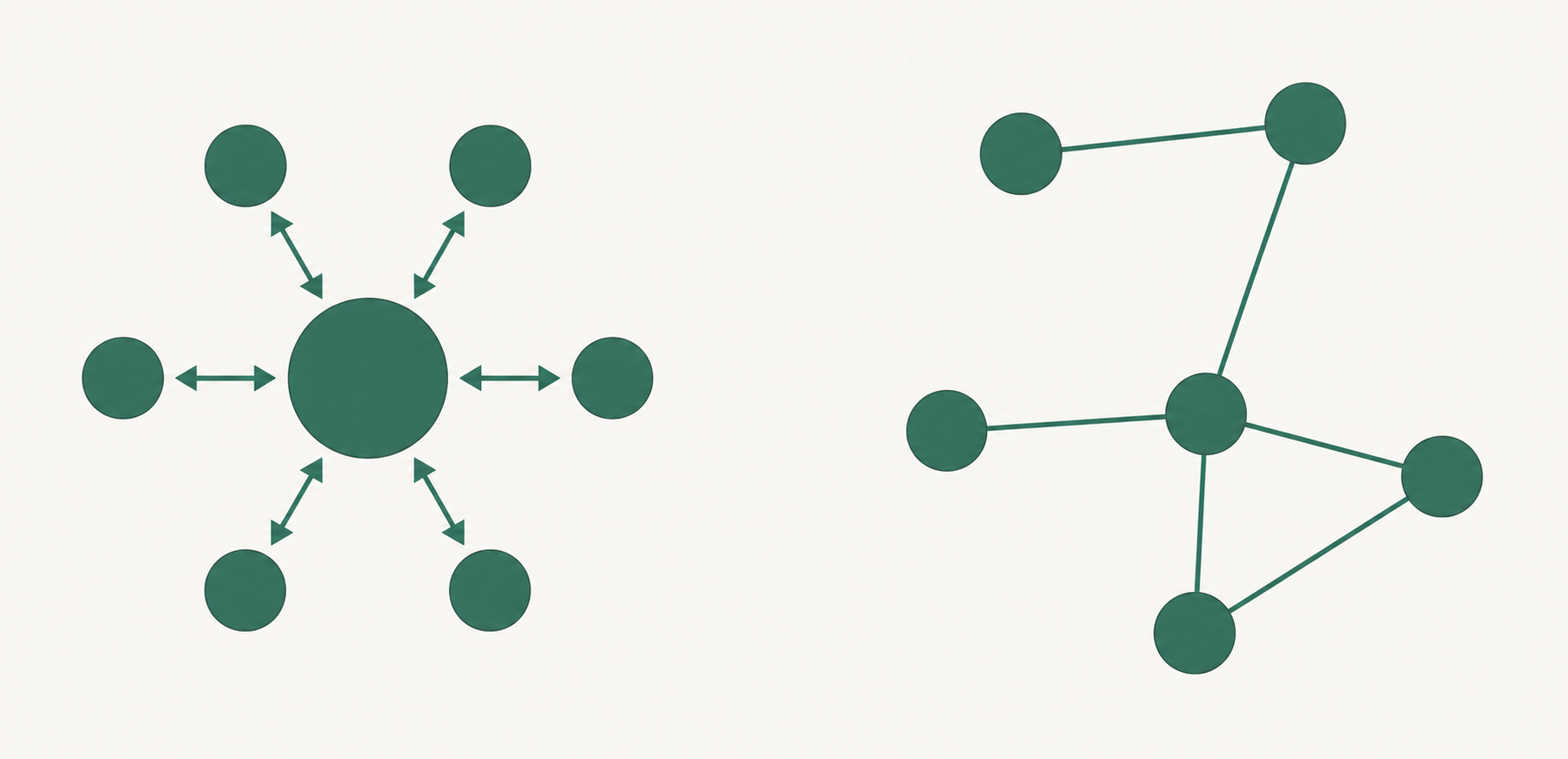
Tapscott’s central claim is that programmable distributed ledgers could record far more than cryptocurrency, extending to many kinds of transaction, asset and right. The opportunity is substantial where shared trust is costly, although describing any ledger as “incorruptible” overstates the guarantee.
Proposed applications reduce or reshape the role of intermediaries in areas including:
- Remittances:
- transferring funds in hours rather than days and potentially lowering fees in a market then worth about $0.5 trillion.
- Smart contracts:
- executing programmed conditions for uses such as derivatives; Ethereum was designed as an open-source platform for this capability.
- Crowdfunding:
- coordinating contributions and distributing tokenised rights in new ways.
- Securities markets:
- Nasdaq announced a blockchain trial for proxy voting in Estonia.
- The sharing economy:
- enabling peer-to-peer markets that could reduce dependence on platforms such as Airbnb, Uber or eBay; OpenBazaar demonstrated one such decentralised-market approach.
- Creative rights:
- helping authors, musicians and artists document ownership and receive a defined share of value.
- Land registration:
- strengthening the traceability of claims, particularly where property records are fragile—provided that legitimate rights are verified before being entered.
In 2015, the World Economic Forum’s Global Agenda Council on the Future of Software and Society surveyed 800 technology executives and experts. More than half expected blockchain-held value to reach 10 per cent of global GDP by 2025, defining the technology broadly as a substitute for third-party trust in financial, contractual and voting activity. This was an expectations survey, not a measured forecast model, and the date should now be read as historical evidence of the period’s optimism rather than a current projection.
Continue your preview
Read more of Blockchain technology (Tapscott).
Create a free account to continue this advanced article preview. Complete access is available with Pro or an eligible outcome pack, so you can see the value before deciding to upgrade.